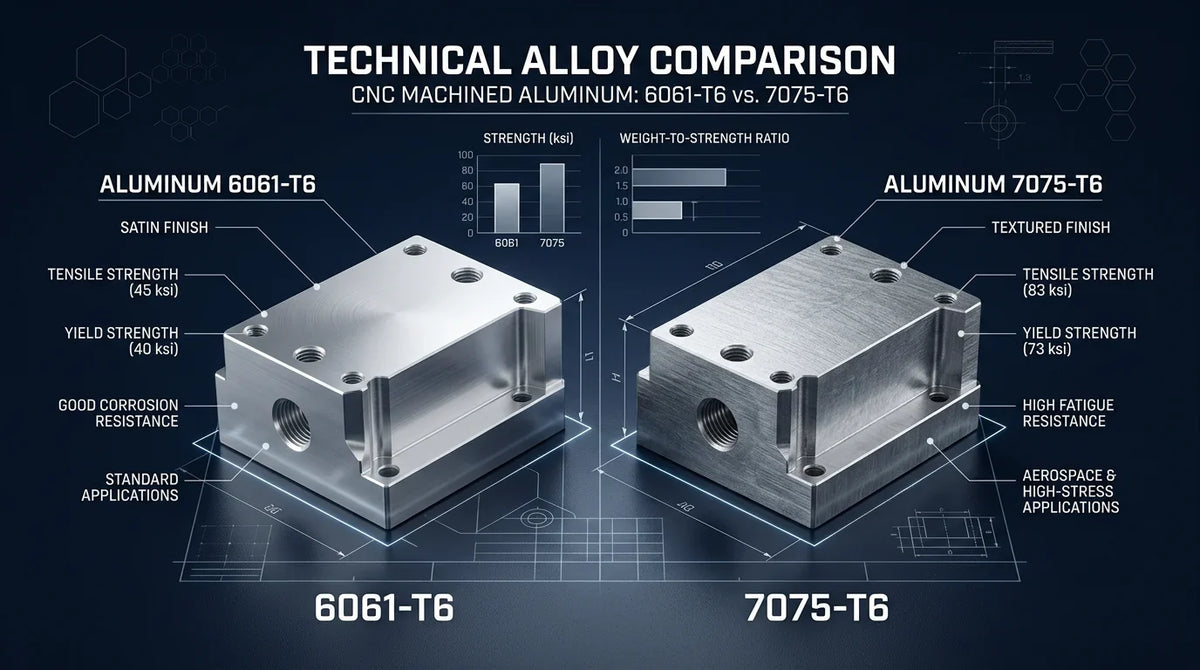
Choosing between aluminum 6061 and 7075 is one of the most common dilemmas in CNC machining — both look similar on a spec sheet, but pick the wrong one and you waste budget or risk a part that fails in service. Here is the engineer-to-engineer breakdown.
Quick verdict
- Choose 6061-T6 if you need a general-purpose, weldable, corrosion-resistant aluminum at the lowest cost. It covers ~80% of CNC parts.
- Choose 7075-T6 if your part is structural, lightly loaded but needs aerospace-grade strength, and weldability + corrosion are not deal-breakers.
Mechanical properties side by side
| Property | 6061-T6 | 7075-T6 |
|---|---|---|
| Tensile strength | 310 MPa | 572 MPa |
| Yield strength | 276 MPa | 503 MPa |
| Elongation | 12% | 11% |
| Hardness (Brinell) | 95 | 150 |
| Density | 2.70 g/cm³ | 2.81 g/cm³ |
| Machinability rating | Excellent | Good |
| Weldability | Excellent (TIG/MIG) | Poor — not recommended |
| Corrosion resistance | Very good | Fair (needs coating) |
| Relative cost | 1.0× | 1.6–2.0× |
When 6061-T6 is the right call
6061-T6 is the workhorse alloy of CNC. It machines beautifully, anodizes evenly, welds without fuss, and resists corrosion in marine and outdoor environments. Use it for:
- Brackets, housings, enclosures, plates
- Frames and chassis where weight is moderate
- Anything that needs welding (jigs, fixtures, weldments)
- Outdoor or marine parts
- Cost-sensitive prototypes and production runs
When 7075-T6 is the right call
7075-T6 trades weldability and corrosion resistance for raw strength — it rivals some mild steels at one-third the weight. Reach for it when:
- Aerospace structural parts (ribs, brackets, fittings)
- High-stress jigs and tooling
- Sporting goods (bike frames, climbing gear, archery risers)
- Defense parts where strength-to-weight is critical
Five common mistakes
- Specifying 7075 for a welded assembly. 7075 is essentially unweldable — micro-cracks form in the heat-affected zone. Use 6061 or mechanical fasteners.
- Using 7075 outdoors without a coating. 7075 corrodes faster than 6061. Always anodize or alodine for outdoor service.
- Paying 7075 prices for a non-structural part. If the part sees moderate loads, 6061 saves you 40–50% on material.
- Assuming 7075 machines like 6061. 7075 is harder, work-hardens faster, and needs sharper tooling and lighter cuts.
- Skipping heat treat callouts. Always specify the temper (T6 is standard for both). T651 is preferred for plate stock to relieve residual stress.
Cost reality check
For a typical 100 × 100 × 25 mm milled part:
- 6061-T6: ~$28–35 in material + ~$45 in machining = $73–80
- 7075-T6: ~$48–62 in material + ~$55 in machining = $103–117
That is roughly a 40–50% premium for 7075. If your part does not actually need 500+ MPa of yield, that money is wasted.
The decision rule we use at Alloyer
Default to 6061-T6 unless one of three conditions is true: (1) the part is a structural element under high cyclic load, (2) weight savings of 30%+ vs steel are required, or (3) the customer specifies it (often aerospace customers do). When in doubt, send your CAD to our DFM team — we will recommend the alloy that meets your spec at the lowest cost.
Get a quote on either alloy
Upload your STEP file to our instant quoting tool — you can compare 6061 and 7075 side-by-side in real time, with no MOQ.