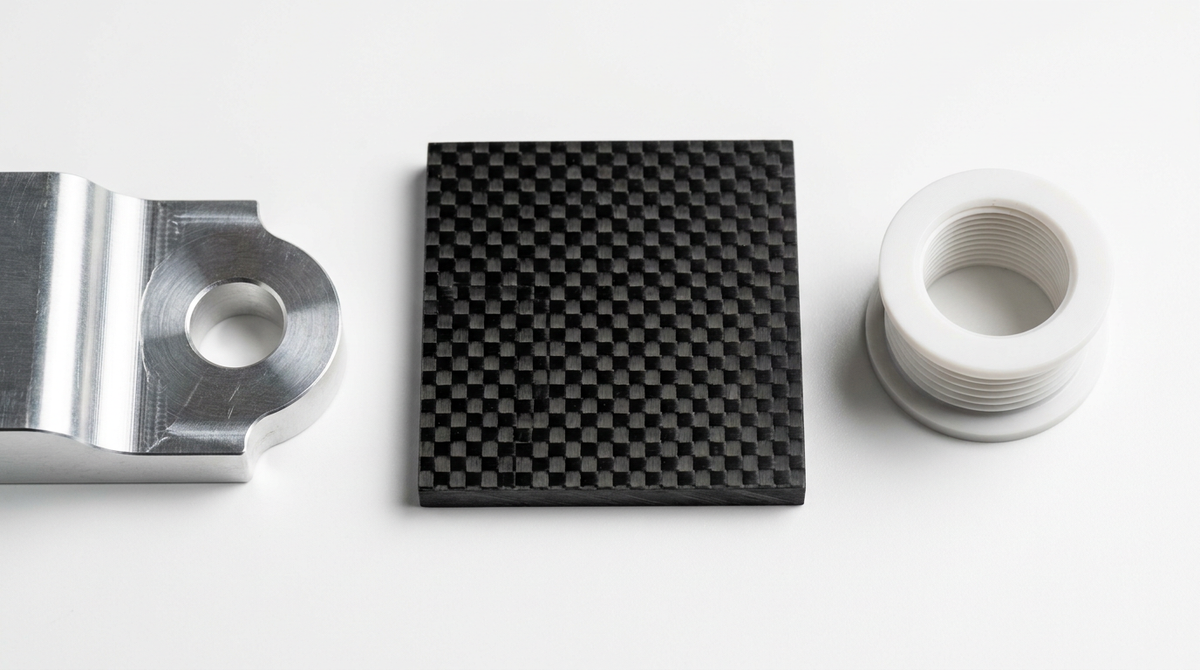

Choosing the best materials for humanoid robot arms involves a complex trade-off between structural stiffness, total mass, and the manufacturing complexity of high-DOF (Degree of Freedom) assemblies. Alloyer specializes in precision CNC manufacturing for robotics, offering rapid prototyping and material-specific DFM reviews to ensure your design moves from CAD to hardware in under 72 hours.
Key Things to Know
1. Aluminum 7075-T6: The High-Stress Specialist
Aluminum 7075-T6 is the "aerospace grade" alloy of choice for humanoid robot arm joint housings and actuator brackets. While 6061-T6 is sufficient for static frames, the dynamic loads in a humanoid shoulder or elbow require the 500+ MPa yield strength of the 7000 series.
Properties
Best For
CNC Considerations
Aluminum 7075-T6 has good machinability (Rating B), but it is harder than 6061. It produces short, brittle chips that are easy to manage in high-speed milling. For robot arm components, Alloyer uses carbide tooling with high-positive rake angles to achieve Ra 0.8 μm finishes on bearing bores.Cost
2. Carbon Fiber: The Inertia Killer
In humanoid robotics, the mass of the distal segments (forearm/wrist) significantly impacts the torque required at the proximal joints (shoulder). CNC-machined carbon fiber plates or tubes are used for the long structural links of the arm to minimize this inertia.
Properties
Best For
CNC Considerations
Machining carbon fiber is classified as "Difficult" (Rating E). It requires specialized diamond-coated tooling to prevent fiber fraying and delamination. At Alloyer, we utilize high-RPM spindles and vacuum-assisted dust extraction to ensure clean, precise edges on custom CF arm links.Cost
3. PEEK: The Engineering Plastic Bridge
PEEK (Polyetheretherketone) is often used for specific humanoid arm components that require electrical insulation, low friction, or weight savings in non-structural areas.
Properties
Best For
CNC Considerations
PEEK has medium machinability (Rating C). It is prone to thermal expansion during the cutting process, which can lead to dimensional drift. Alloyer manages this by using specialized coolant strategies and stress-relieved stock to maintain ±0.02 mm tolerances.Cost
Material Comparison Table
| Material | Density (g/cm³) | Yield Strength (MPa) | Machinability | Cost Index* | Best Robot Arm Use |
|---|---|---|---|---|---|
| Al 6061-T6 | 2.70 | 276 | Excellent | 1.0x | Main chassis, non-load links |
| Al 7075-T6 | 2.81 | 503 | Good | 1.5x | Joint housings, high-stress links |
| Carbon Fiber | 1.60 | 1500+ | Difficult | 5.0x | Long-reach structural tubes |
| PEEK | 1.30 | 90 | Medium | 15.0x | Sensor mounts, insulated parts |
| Titanium Gr 5 | 4.43 | 880 | Poor | 8.0x | Wrist pins, ultra-compact joints |
DFM Tips for Humanoid Robot Arm Parts
1. Bearing Seat Tolerances: Always specify H7 (+0.021/0 mm) for bearing bores in 7075 aluminum. Anything looser leads to joint backlash; anything tighter risks bearing seizure. 2. Thread Engagement: For motor mount bolts, ensure a minimum thread engagement of 2.5x the bolt diameter in aluminum (e.g., 7.5mm depth for an M3 screw) to prevent stripping during high-torque operation. 3. Lightweighting (Pocketing): Use a corner radius of at least 3 mm in lightened pockets to allow for larger, more rigid end mills (6mm diameter), which reduces machining vibration and cost. 4. Surface Treatment: For 7075 aluminum joints, specify Type III Hardcoat Anodizing. This creates a wear-resistant surface that prevents galling at the interface between moving arm components.
FAQ
What is the best material for a robot arm's humerus?
For humanoid robots, Carbon Fiber tubes or 7075-T6 Aluminum I-beams are preferred. Carbon fiber offers the lowest mass, while 7075 provides better impact resistance and easier integration of motor mounts.Why not use 6061 aluminum for all parts?
While 6061 is cost-effective, it lacks the fatigue strength required for humanoid joints. Over thousands of cycles, 6061 joint housings can develop "play" or bore ovalization, whereas 7075 remains dimensionally stable.How much can I reduce weight by using Carbon Fiber?
Switching a humanoid forearm segment from 6061 aluminum to carbon fiber typically yields a 40-45% weight reduction, which drastically reduces the torque requirement for the elbow actuator.Does Alloyer offer 5-axis machining for organic arm geometries?
Yes. Humanoid limbs often require complex, organic shapes for aerodynamic or aesthetic reasons. Our 5-axis simultaneous milling centers can produce these geometries with Ra 1.6 μm finishes in a single setup.How do I get an instant price for my robot arm design?
You can upload your CAD files (STEP/IGES) to the Alloyer Quote Engine. Our AI will analyze your geometry, provide DFM feedback, and generate an instant manufacturing price.---
Ready to machine your robot arm components? Upload your CAD for an instant DFM review and material recommendation. 1-piece prototyping accepted. Get Quote →