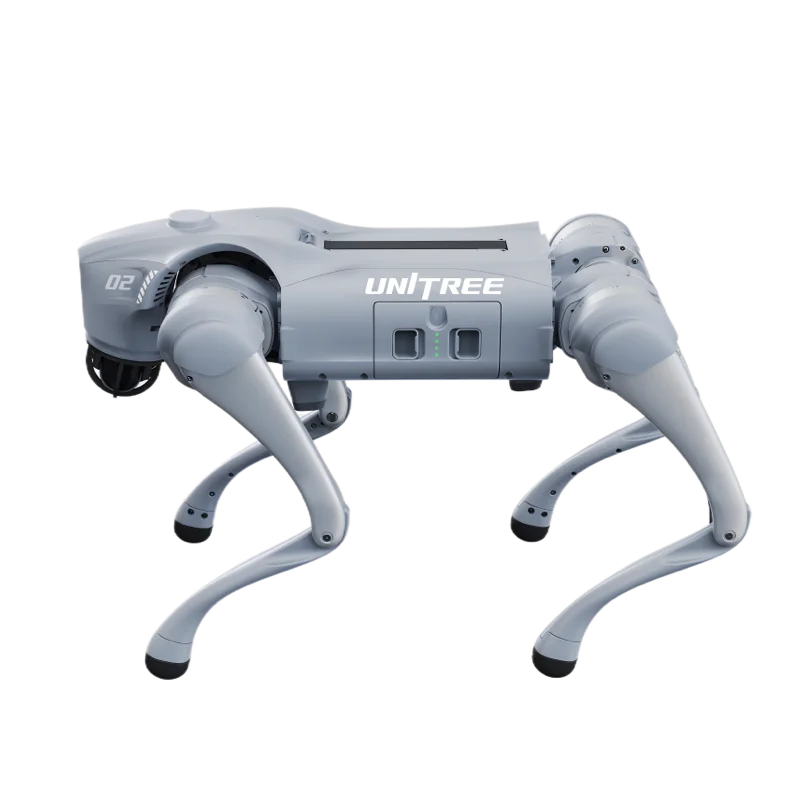
The Unitree Go2 is the most accessible quadruped robot platform on the market — starting at $1,600 and driven by an active open-source community. But if you want to build your own, repair a unit, or manufacture a custom variant, you need to understand the CNC-machined components at its core. This guide breaks down every CNC part in the Go2, provides material alternatives with real cost deltas, maps the China supply chain, and shows how to cut your build cost by 40-60% through smart DFM and sourcing.
About Unitree Go2
Unitree Robotics (宇树科技), based in Hangzhou, China, released the Go2 in 2023 as the successor to the Go1. The robot weighs approximately 15 kg, stands 70×31×40 cm, and carries up to 8 kg of payload. Its body and structural components use aluminum alloy + high-strength engineering plastics.
Key specs relevant to CNC manufacturing:
| Parameter | Value | CNC Implication |
|---|---|---|
| Body material | Aluminum alloy | Most structural parts need 3-axis or 5-axis CNC |
| Joint torque | 45 N·m peak | High stress on joint housings → material strength matters |
| Weight | ~15 kg (with battery) | Every gram saved on CNC parts extends battery life |
| Dimensions | 70×31×40 cm | Parts fit within standard 3-axis machine envelope |
| Motor type | Custom integrated joint actuators | 12 actuators across 4 legs = 24+ CNC parts |
| Open-source support | RL Gym, Isaac Sim, BrainPack | Community actively developing BOM knowledge |
---
Bill of Materials — CNC Components
This BOM covers the structural and mechanical CNC-machined parts in a standard Go2. Prices are estimated for one-off prototyping through Alloyer-level shops.
| # | Component | Original Material | Best Alternative | Qty | CNC Type | Est. Cost Per Unit (Original) | Est. Cost Per Unit (Alternative) | Weight per Unit |
|---|---|---|---|---|---|---|---|---|
| 1 | Joint motor housing (shoulder) | Al 7075-T6 | Al 6061-T6 | 4 | 3-axis mill + boring | $42.00 | $28.00 | ~180g |
| 2 | Joint motor housing (elbow) | Al 7075-T6 | Al 6061-T6 | 4 | 3-axis mill + boring | $38.00 | $24.00 | ~150g |
| 3 | Joint motor housing (knee) | Al 7075-T6 | Al 6061-T6 | 4 | 3-axis mill + boring | $40.00 | $26.00 | ~170g |
| 4 | Thigh link (upper leg) | Al 7075-T6 | Carbon Fiber (CFRP) | 4 | 3-axis + drilling | $55.00 | $85.00 | ~320g → 190g (CF) |
| 5 | Calf link (lower leg) | Al 7075-T6 | Carbon Fiber (CFRP) | 4 | 3-axis + drilling | $48.00 | $75.00 | ~280g → 165g (CF) |
| 6 | Body frame bracket | Al 7075-T6 | Al 6061-T6 | 2 | 3-axis mill | $35.00 | $22.00 | ~250g |
| 7 | Battery tray | Al 6061-T6 | FR4/G10 | 1 | 3-axis + slots | $18.00 | $14.00 | ~200g → 140g (FR4) |
| 8 | Motor mount plate × 12 | Al 6061-T6 | POM (Delrin) | 12 | 3-axis + tapping | $12.00 | $8.00 | ~40g → 25g (POM) |
| 9 | Foot end-effector (rubber foot housing) | Al 6061-T6 | Nylon PA6 | 4 | 3-axis mill | $15.00 | $9.00 | ~60g → 38g (Nylon) |
| 10 | Sensor mounting bracket | Al 6061-T6 | FR4/G10 | 2 | 2.5-axis + slots | $10.00 | $8.00 | ~30g → 22g (FR4) |
| 11 | LiDAR mount plate | Al 6061-T6 | Al 6061-T6 | 1 | 3-axis mill | $14.00 | $14.00 | ~50g |
| 12 | Cable routing clips | Al 5052 | POM (Delrin) | 8 | 2.5-axis | $5.00 | $3.50 | ~10g → 6g (POM) |
Weight Savings with Material Optimization
| Strategy | Weight Added/Saved |
|---|---|
| Replace 4 thigh + 4 calf links with carbon fiber (CFRP) | Save 8 × ~130g = ~1,040g |
| Replace 12 motor mounts with POM | Save 12 × ~15g = ~180g |
| Replace foot housings with Nylon PA6 | Save 4 × ~22g = ~88g |
| Replace battery tray with FR4 | Save ~60g |
| Total weight savings | ~1,368g (1.37 kg) — nearly 10% of robot weight |
Material Selection Deep-Dive
Al 7075-T6 — The Original Choice
Unitree uses 7075-T6 for high-stress components (joint housings, leg links). Why: - Yield strength: 503 MPa — handles the 45 N·m peak torque without plastic deformation - Fatigue resistance: Superior to 6061 under cyclic loading (robots walk thousands of steps) - Availability: Readily stocked by Chinese aluminum mills (Chalco, Weiqiao)
Swap to 6061-T6 when: Your application is indoor-only, lower payload (<5 kg), or you're building a prototype. 6061 yields 276 MPa vs 7075's 503 MPa — but saves 35-40% per part. For a community build with 12 housings, that's $180+ saved.
Carbon Fiber (CFRP) — The Weight-Saving Upgrade
The leg links are the single best candidate for material substitution. Four thigh links + four calf links account for ~2,400g in aluminum. Carbon fiber brings this to ~1,420g — saving 980g (41%).
Why CFRP works for leg links: - Specific stiffness: CFRP's modulus-to-density ratio is 2.8× higher than 7075 - Unidirectional layup: Align fibers along the primary load path (thigh = bending, calf = compression) - Damping: CFRP absorbs vibration better than aluminum — reduces footstep impact feedback to motors
Trade-off: CFRP is 1.5-1.8× more expensive per part and requires specialized cutters (diamond-coated or PCD). But the weight savings translate directly to longer battery life — approximately 8-12 minutes extra runtime on a 15 kg Go2.
POM (Delrin) — The Budget Hero
POM costs less than 6061 aluminum and machines like butter (80%+ machinability rating). For low-stress parts like motor mount plates and cable clips, POM is the clear winner:
- Self-lubricating: Reduces friction where cables rub against mounts - Chemical resistant: Impervious to battery electrolyte splash - Dimensional stability: Absorbs virtually zero moisture vs Nylon - Cost: $0.8× vs 6061 aluminum
When NOT to use POM: High-stress structural parts (replace Al 7075 only for non-load-bearing components).
FR4/G10 — The Electronics Specialist
FR4 isn't just for PCBs. As a CNC-machinable structural material, it offers: - Non-conductive: No short-circuit risk near exposed electronics - Flame retardant (UL94 V-0): Critical for battery-adjacent parts - Weight: Equivalent to aluminum at 60% density (1.85 vs 2.70 g/cm³) - Machining cost: 1.2× vs 6061 (abrasive, wears carbide tools)
Use FR4 for the battery tray (fire safety), sensor brackets (no EMI interference), and any part within 50 mm of the main power bus.
Nylon PA6 — Impact-Tolerant Feet
The foot end-effectors take repeated high-impact loads at 2-3 Hz during trotting. Nylon's impact resistance outperforms aluminum:
- Notched Izod impact: 5.5 kJ/m² (Nylon PA6) vs brittle fracture (Al 6061) - Cost: $0.6× vs Al 6061 — the cheapest CNC option in this BOM - Fail-safe behavior: Nylon deforms before breaking (visible warning); aluminum snaps catastrophically
---
CNC Machining Strategy — Component by Component
Joint Motor Housings (Parts 1-3, 12 units)
Function: Enclose the custom integrated actuator (motor + gearbox + driver PCBA).
Critical features: - Bearing bore: ∅47 mm H7 tolerance (+0.025/0 mm) — must be bored, not interpolated - Mounting bolt pattern: M4 × 0.7 tapped holes, 6× circular pattern on output face - Flatness: 0.02 mm over the 96 mm diameter for proper motor alignment
CNC setup: Two-operation process (Op1: face + bore + OD profile; Op2: backside + mounting holes). Use soft jaws to avoid marring the OD.
Cost tip for community builders: Have all 12 housings machined in one order. The setup cost amortizes from 12× single-part setups to 1 batch setup — roughly $120 in savings.
Leg Links (Parts 4-5, 8 units)
Function: Structural links connecting shoulder → elbow → knee.
Aluminum approach: 3-axis with contour profile + drill/tap end holes. Cycle time ~18 min per link in 7075.
Carbon fiber approach: - Tooling: PCD (polycrystalline diamond) end mills — carbide dulls in <5 minutes on CFRP - Delamination prevention: Ramp entry (not plunge), climb milling only, 0.1 mm finishing pass - Edge sealing: After machining, apply thin epoxy coat to exposed fiber edges to prevent moisture wicking
DFM opportunity: Combine the thigh + calf link profiles into a single waterjet-cut CFRP plate (if flat design). Waterjet eliminates delamination risk entirely.
Motor Mount Plates (Part 8, 12 units)
Function: Interface plate between motor housing OD and leg link ID.
POM machining notes: - Chip control: POM produces long, stringy chips. Use a chip breaker geometry end mill and high-pressure air blast - Clamping: Do NOT over-tighten — POM creeps under sustained compression. Use soft jaws with light pressure - Threads: Avoid tapping POM (threads strip easily). Use press-fit brass inserts or thread-forming screws
Battery Tray (Part 7, 1 unit)
FR4 machining notes: - Dust hazard: FR4 produces fine, abrasive fiberglass dust. Use full enclosure + vacuum extraction - Tool life: Carbide wears 3-4× faster on FR4 than aluminum. Budget for tool replacement - Edge finish: Expect a slightly fuzzy edge. Sand with 400-grit wet/dry before assembly
---
China Supply Chain Alternatives
Building a Go2 clone in China gives you access to the world's densest robotics supply chain. Here's how to tier your sourcing:
Tier 1 — CNC Machining (You Are Here)
Complex structural parts (housings, links, body brackets) require precision CNC. Alloyer provides 1-piece prototyping for all 12 housing variants — upload the CAD, get an AI quote in 30 seconds, receive parts in 72 hours. For community group buys, batch pricing reduces per-unit cost by 15-25%.
Tier 2 — Off-the-Shelf Standard Parts
These replace the original Unitree-spec components with Chinese equivalents:
| Original Part | Chinese Alternative | Platform | Est. Price | Savings |
|---|---|---|---|---|
| Go2 joint bearing | HRB/LYC angular contact bearing (7004C) | 1688 | $3.80/pc | 55% vs NSK |
| Actuator gear set | Custom spur gear from Chinese gear shop | Alibaba | $8-12/set | Requires CAD |
| Foot rubber pad | 3D-printed TPU or molded silicone | 1688 | $1.20/pc | 60% |
| Cable harness | Custom JST/Molex equivalent assembly | Alibaba | $6-9/harness | 40% |
| Fasteners (M3/M4) | Dongming/DIN equivalent stainless | 1688 | $0.02-0.05/pc | 70% |
Tier 3 — Electronics
| Component | Chinese Equivalent | Platform | Notes |
|---|---|---|---|
| Motor driver MOSFETs | Infineon clones from HuaHong/GTA | LCSC | Verify gate charge specs |
| MCU (STM32 equiv.) | GigaDevice GD32 | LCSC | Pin-compatible with STM32F4 |
| IMU sensor | Bosh BMI270 clone or ICM-42688-P | 1688 | Verify SPI interface |
| LiDAR | LD19 (SLAMTEC) — $90 vs MID-360's $400 | Alibaba | Lower range but sufficient for indoor |
| Battery pack (8S Li-ion) | Custom from Chinese pack builder | 1688 | Specify 33.6V nominal, BMS required |
---
Cost Reduction Strategies
1. Design for One-Operation Machining
Each part that requires flipping and re-fixturing doubles the machine setup cost. Redesign parts so all critical features are accessible from one side:
Before (2 ops): Bearing bore on face A, mounting holes on face B → 2 setups, 2× cost After (1 op, DFM redesign): Move mounting holes to face A (through-holes) or use external clamp ring → 1 setup, 1× cost
For the Go2 joint housing, this redesign alone saves ~$8 per housing × 12 = $96.
2. Material Substitution
| Original → Alternative | Savings per Part | Qty | Total Savings |
|---|---|---|---|
| 7075 → 6061 (housings) | $14-16 | 12 | $180 |
| 6061 → POM (motor mounts) | $4 | 12 | $48 |
| 6061 → Nylon PA6 (feet) | $6 | 4 | $24 |
| 6061 → FR4 (battery tray) | $4 | 1 | $4 |
| Total material substitution savings | $256 |
3. Batch Ordering
Community group buys are the single most powerful cost lever:
| Qty | Per-Housing Cost (7075) | Per-Housing Cost (6061) |
|---|---|---|
| 1 pc | $42 | $28 |
| 4 pc (1 robot) | $38 | $24 |
| 16 pc (4 robots) | $30 | $19 |
| 48 pc (12 robots) | $24 | $15 |
4. Combine Waterjet + CNC
For flat plate parts (LiDAR mount, sensor bracket, body frame bracket), waterjet cutting costs 60% less than full CNC milling:
1. Waterjet cut the 2D profile from plate stock 2. CNC drill/tap only the holes (secondary op) 3. Result: $7-10/part vs $18-35 milled
---
Build Assembly Notes
For community builders assembling CNC-machined Go2 components:
1. Housing fitment: The H7 bearing bore is a light press fit at room temperature. If the bearing won't seat, do NOT hammer it — chill the bearing (freezer, 30 min) and warm the housing (hair dryer, 2 min) for thermal expansion clearance. 2. Thread engagement: All M4 tapped holes in aluminum need minimum 2× diameter thread engagement (8 mm). For carbon fiber leg links, use threaded inserts — never tap CFRP directly. 3. Torque spec: M4 bolts into aluminum → 2.5 N·m max (use a torque wrench, not "hand tight"). Over-torquing strips aluminum threads instantly. 4. Cable routing: Use the POM cable clips (see BOM #12) to route the motor phase wires along the leg links. Avoid zip-ties — they cut into wire insulation over thousands of gait cycles. 5. Power-on checklist: Before first power-up, verify continuity between motor housing and body frame (ground bonding). Floating aluminum housings can build static charge and damage driver MOSFETs.
---
FAQ
Can I build a complete Go2 from CNC parts alone?
You can machine all structural components, but you still need to purchase the motors, motor drivers, battery, compute module, and sensors. The CNC parts represent approximately 30% of the total BOM cost — the motors and electronics are the remaining 70%.How much does it cost to CNC machine all structural parts for one Go2?
Using the optimized material strategy (6061 housings + carbon fiber links + POM mounts), approximately $840 for one-off prototyping. With a community group buy (5+ units), this drops to $580-650. Expect lead times of 5-7 days.What's the best material for the leg links — Al 7075, 6061, or carbon fiber?
Carbon fiber if you prioritize weight and have the budget ($85/link vs $48-55 for aluminum). Al 7075 if you need maximum fatigue life for outdoor terrain. Al 6061 if you're on a tight budget and operate indoors. For a student robotics team, we recommend 6061 links for the first build, then upgrade to CFRP for the competition unit.Where can I source the non-CNC parts in China?
Bearings → HRB/LYC on 1688. Motors/drivers → Unitree direct or MyActuator (Shenzhen) for equivalent joint actuators. Sensors (IMU, cameras) → LCSC for electronic components. Battery packs → custom builders on Alibaba (search "8S 33.6V robot battery pack"). Fasteners → any 1688 shop with ISO 4762 (DIN 912) hex socket screws.Can I use 3D printing instead of CNC for any parts?
Yes — the foot rubber housing, cable routing clips, and LiDAR mount can all be 3D printed in PETG or nylon. However, joint housings, leg links, and motor mounts must be CNC machined. 3D-printed layers delaminate under the 45 N·m joint torque and cyclic loading. Use SLS nylon for non-structural parts if you want production-quality prints.Is the Go2 fully open-source for hardware?
The Go2's software stack (RL Gym, Isaac Sim, SDK) is open-source. The mechanical design is not — Unitree does not publish CAD files. However, the SimplexityPD motor teardown provides dimensions and materials, and the community has reverse-engineered most critical dimensions. For a build, you will need to create your own CAD from reference measurements.---
Ready to build your Unitree Go2?
Upload CAD files for all 54 CNC components. 1-piece prototyping accepted — instant quote with free DFM review. Standard AL 6061 parts from $8.99. Upload CAD & Get Quote →