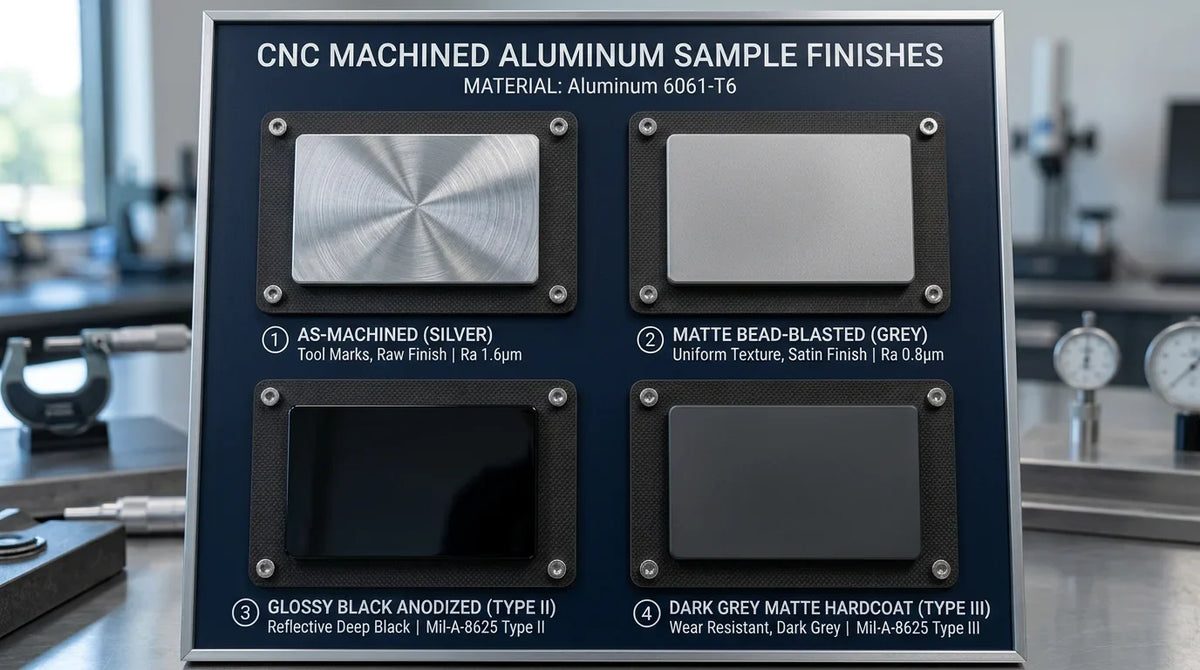
Surface finish is the single most-overlooked spec on a CNC drawing. Get it right and your part looks like a finished product; get it wrong and you pay for rework or end up with a part that corrodes in three months. This guide explains the seven finishes Alloyer offers and when to use each.
The seven CNC finishes at a glance
| Finish | Best for | Cost adder | Lead time adder |
|---|---|---|---|
| As-machined | Internal parts, prototypes | — | — |
| Bead blast | Uniform matte cosmetic finish | +5–10% | +1 day |
| Anodize Type II | Color, mild corrosion protection | +15–25% | +3–5 days |
| Anodize Type III (hardcoat) | Wear resistance | +30–45% | +5–7 days |
| Powder coating | Thick, durable color layer | +10–20% | +3–5 days |
| Electropolish | SS for medical / food | +20–30% | +3–5 days |
| Black oxide | Carbon steel — mild corrosion | +10–15% | +2–3 days |
1. As-machined
The default. Surface roughness Ra 1.6–3.2 µm depending on tooling. Tool marks visible. Suitable for internal parts, prototypes, and anything that will be coated later. Free.
2. Bead blast
Glass or aluminum-oxide media is blasted at the part to produce a uniform matte finish. Hides tool marks, gives a premium look, and creates a great surface for anodizing. Ra ~1.6 µm. Specify bead size (#100 fine, #80 medium, #40 coarse).
3. Anodize Type II (decorative)
An electrochemical process that grows a 5–25 µm aluminum-oxide layer. Available in clear, black, red, blue, gold, and dozens of custom colors. Mild corrosion protection. Common spec: "Anodize Type II, Class 2, color black per MIL-A-8625." Aluminum only.
4. Anodize Type III (hardcoat)
A thicker (25–75 µm), denser oxide layer. Surface hardness ~Rc 60. Used on parts that slide or rotate (pistons, gear housings, weapon parts). Usually black or dark grey — color options limited. Aluminum only.
5. Powder coating
Electrostatically applied dry powder cured at 200°C. Builds a 50–150 µm color layer that resists chips and UV. Best for outdoor enclosures, brackets, and consumer products. Works on aluminum, steel, and stainless. RAL color codes accepted.
6. Electropolish
Reverse electroplating — strips a thin layer of metal to leave a mirror-bright, ultra-clean surface. Required for medical, pharmaceutical, and food-grade stainless parts. Reduces surface roughness to Ra ≤0.4 µm. Stainless steel and titanium.
7. Black oxide
A hot chemical bath converts the steel surface to magnetite (Fe3O4). Produces a thin (1–5 µm) black layer with mild corrosion resistance — needs an oil seal to perform. Common on tool steel, fasteners, and gun parts. Carbon steel only.
How to choose
- Functional first. Will the part see corrosion, wear, or sliding contact? Choose hardcoat anodize, electropolish, or powder coat accordingly.
- Cosmetic second. If the part is consumer-facing, bead blast + Type II anodize is the gold standard for aluminum.
- Match the alloy. Anodize only works on aluminum; black oxide only on carbon steel; electropolish best on stainless.
- Spec the standard. Always cite a standard (MIL-A-8625, ASTM B580, AMS-2700) so the supplier knows exactly what to deliver.
Five common mistakes
- Asking for "anodized" without specifying type or color. Type II Class 1 (clear) and Class 2 (color) behave very differently — and Type III is a different process altogether.
- Powder coating tight tolerances. Powder coat adds 50–150 µm of thickness — masks needed on mating surfaces, threads, and bores.
- Electropolishing welds. Electropolish exposes weld defects. Always inspect welds before electropolishing.
- Bead blasting before anodizing — but skipping the spec. Bead size dramatically changes the look. #100 looks satin; #40 looks coarse and grey.
- Forgetting masks. Tapped holes, press-fit bores, and ground surfaces all need masking. Call them out on the drawing.
Get a quote with finish included
Our instant quoting tool lets you select a finish and color in one click. Upload your STEP file and see the cost adder for each finish in real time.