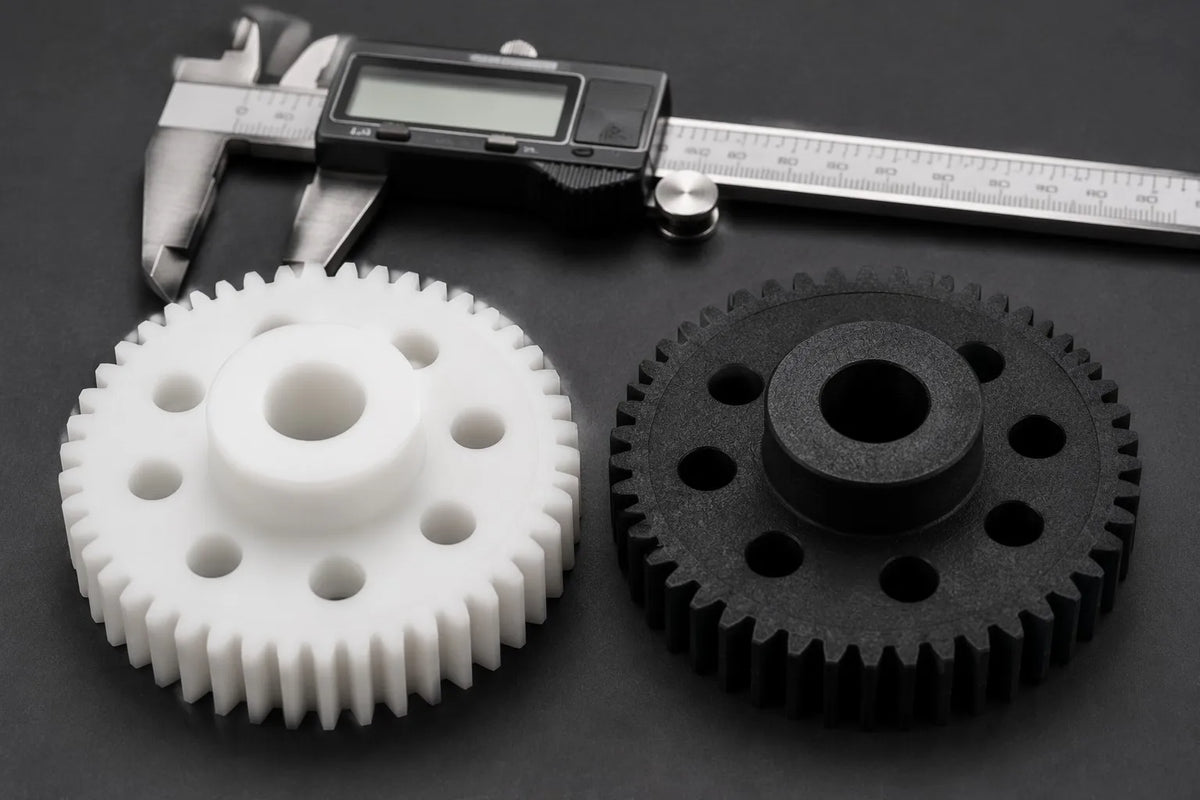
POM (Delrin) and Nylon (PA6/PA12) are the two most widely used engineering plastics in robotics, but they serve fundamentally different roles. POM wins for precision gears, bushings, and any component requiring dimensional stability and self-lubrication, while Nylon excels in impact-resistant structural spacers, cable guides, and vibration-damped mounts — as long as its moisture sensitivity is accounted for in the design. Alloyer CNC-machines both materials with 72-hour prototyping, helping you make the right choice for each specific component in your robot.

Key Differences at a Glance
| Property | POM (Delrin) | Nylon PA6 | Winner |
|---|---|---|---|
| Density | 1.41 g/cm³ | 1.14 g/cm³ | Nylon (19% lighter) |
| Yield Strength | 65 MPa | 60 MPa (dry) / 35 MPa (wet) | POM (stable, no moisture loss) |
| Moisture Absorption (24h) | 0.25% | 1.5–3.0% (PA6) / 0.5–1.5% (PA12) | POM (10x lower) |
| Friction Coefficient (vs Steel) | 0.2–0.35 | 0.3–0.5 | POM (self-lubricating) |
| Impact Toughness (Izod) | 75 J/m | 110 J/m (dry) | Nylon (47% tougher) |
| Machinability | Excellent | Good (stringy chips) | POM |
| Cost per kg (CNC-grade) | $8–12 | $5–8 (PA6) / $12–18 (PA12) | Nylon PA6 (budget) |
| CNC Lead Time | 3–5 days | 3–5 days (PA6) / 5–7 days (PA12) | Tie |
When to Choose POM (Delrin)
Precision Gears and Transmission Components
POM is the default engineering plastic for robot gears. Its 0.2–0.35 friction coefficient against steel means POM gears can run against steel pinions without external lubrication — a critical advantage for compact robot joints where grease packing would add bulk and maintenance complexity. POM's dimensional stability (moisture absorption of only 0.25% after 24 hours of water immersion) means gear tooth profiles remain accurate regardless of ambient humidity. A POM gear machined to ±0.02 mm in a dry workshop in Arizona will fit identically in a humid factory in Singapore.
Bushings and Sliding Bearings
POM's self-lubricating property makes it the material of choice for robot bushings and plain bearings. The material shears off microscopic particles as it wears, which act as a dry lubricant at the sliding interface — similar to how graphite works in a pencil. This is why POM bushings typically last 30,000–50,000 cycles in a dry, clean environment without any maintenance.
Chemical-Resistant Components
POM resists most solvents, fuels, and weak acids. If your robot operates near cutting fluids, lubricant sprays, or battery electrolyte (e.g., in a factory-floor AMR), POM components will not swell, soften, or degrade. Nylon, by contrast, absorbs these fluids through its higher moisture affinity, leading to dimensional drift and strength loss.
Rule of Thumb for POM
Choose POM when your component requires dimensional stability (±0.02 mm over time), low friction against metal, and resistance to moisture or chemicals. The trade-off: POM is 13% denser than Nylon PA6 (1.41 vs 1.14 g/cm³) and 47% less impact-resistant.
When to Choose Nylon (PA6/PA12)
Impact-Absorbing Structural Components
Nylon's 110 J/m Izod impact toughness (47% higher than POM) makes it the better choice for structural spacers, cable guides, and brackets that experience impact or shock loading. A Nylon cable guide on a robot arm that accidentally collides with a fixture will flex and recover; a POM guide in the same situation may crack at the mounting hole. For combat robots or legged robots that experience frequent ground impacts, Nylon footpads and bumper brackets outlast POM by 3–5×.
Vibration-Dampened Mounts
Nylon's higher internal damping (loss tangent ~0.04 vs POM's ~0.02) makes it 2× more effective at absorbing vibration. This is particularly valuable for sensor mounts and camera brackets where transmitted vibration from motors creates image blur or sensor noise. A Nylon PA6 isolator between a motor and an aluminum bracket can reduce transmitted vibration amplitude by 40–60% — POM achieves only 20–30% reduction at the same geometry.
Cost-Sensitive, Non-Precision Applications
Nylon PA6 at $5–8/kg is 30–40% cheaper than POM at $8–12/kg. For non-precision structural spacers, standoffs, and enclosure panels where ±0.1 mm tolerance is acceptable, Nylon delivers adequate performance at the lowest material cost among all machinable engineering plastics. PA12 (Nylon 12) costs more ($12–18/kg) but offers lower moisture absorption (0.5–1.5%) — a good middle-ground when impact toughness is needed but moisture stability matters.
Rule of Thumb for Nylon
Choose Nylon when your component needs impact toughness, vibration damping, or the lowest possible weight and cost — and when you can either (a) design around the moisture-induced dimensional change, or (b) use PA12 for better moisture stability. The trade-off: Nylon swells in humid environments and loses up to 40% of its dry strength when saturated.
The Moisture Problem: Why It Matters for Robot Builders
The single biggest differentiator between POM and Nylon is moisture absorption — and this is where most robot builders make mistakes.
The Numbers
- POM: Absorbs 0.25% water by weight after 24 hours of full water immersion (ASTM D570). In practical terms, a POM gear in a robot operating in a 50% RH lab environment sees negligible dimensional change — typically less than 0.01% linear expansion.
- Nylon PA6: Absorbs 1.5–3.0% water at equilibrium in 50% RH air. This translates to approximately 0.3–0.6% linear expansion — meaning a 50 mm Nylon spacer grows by 0.15–0.30 mm as it equilibrates to ambient humidity over 24–48 hours.
Real-World Impact
A Nylon gear machined to a perfect H7 fit on Monday will be tight by Wednesday if the workshop is humid, or loose if the robot ships from a humid factory to a dry warehouse. This is not a material defect — it's a predictable physical behavior that must be designed around. Alloyer recommends:
1. For Nylon PA6 gears: Design the bore clearance 0.3% larger than the target fit to account for moisture expansion, or specify PA12 for critical gear applications.
2. For POM components: No moisture compensation needed — machine to final dimensions and they stay there.
3. For hybrid assemblies: Never press-fit a POM bushing into a Nylon housing — the Nylon will swell around the POM, crushing the bushing ID and seizing the shaft.
CNC Machining Considerations
Machining POM (Delrin)
Excellent machinability. POM produces clean, brittle chips that clear easily from the cutting zone — no chip-wrapping issues. Recommended: 8,000–15,000 RPM, 0.05–0.15 mm/tooth feed, using sharp polished carbide tools. POM's low glass-transition temperature (~60°C) means cutting temperatures must be kept low — use compressed air or mist coolant. Achieves Ra 0.8–1.6 μm as-machined without polishing. Avoid chlorinated cutting fluids — they chemically attack POM and cause surface cracking within 24 hours.POM machines so cleanly that threads can be tapped directly into the material. M3 threads in POM hold 10–15 N of axial pull-out force — adequate for non-structural fasteners. For load-bearing threads, use Helicoil inserts.
Machining Nylon (PA6/PA12)
Good machinability with one significant challenge: Nylon produces long, stringy chips that wrap around the tool and spindle. This requires aggressive chip-breaking strategies — high feed rates (0.10–0.20 mm/tooth), interrupted peck-drilling cycles, and compressed-air chip evacuation. Recommended: 6,000–12,000 RPM with sharp carbide or HSS tools. Nylon's higher melting point (~220°C) is more forgiving of cutting heat than POM, but surface melting can still produce a gummy finish if feeds are too low.Nylon's moisture content at machining time affects the final dimensions. Alloyer stores Nylon stock in a climate-controlled environment and machines it dry (as-received moisture). If your application demands tighter tolerances, request that the Nylon be oven-dried before machining — this adds 1–2 days to lead time but produces more predictable final dimensions.
Cost Analysis
For a typical robot component — a 60-tooth, 50 mm diameter gear with a 6 mm bore, 8 mm face width:
| Cost Factor | POM (Delrin) | Nylon PA6 | Nylon PA12 |
|---|---|---|---|
| Material cost (blank) | $3.50 | $2.20 | |
| Machining time | 18 min | 22 min* | |
| Tooling wear | Very low | Low | |
| Post-processing | None | Optional drying | |
| Total cost (1 pc, Alloyer) | $28–40 | $22–35 |
At 1-piece prototyping quantities, POM and Nylon PA6 are comparable in total cost — the material savings of Nylon are partially offset by slower machining. At 50+ pieces, Nylon PA6 becomes 15–20% cheaper per part as the machining time difference narrows with optimized CAM programs.
The Verdict
For gears, bushings, and precision sliding components: Choose POM (Delrin). Its dimensional stability, self-lubrication, and clean machinability make it the superior engineering plastic for any robot component where friction, fit, or positional accuracy matters. The slightly higher material cost is recovered by zero moisture-related rework and longer service life. For impact-resistant structural parts, vibration-damped mounts, and cost-sensitive spacers: Choose Nylon PA6 for budget builds or Nylon PA12 when moisture stability is needed alongside impact toughness. Design in the moisture expansion allowance (0.3% clearance) and Nylon performs reliably for years. For the absolute best of both worlds: Use carbon-fiber-filled Nylon — it combines Nylon's impact toughness with POM-level dimensional stability (CF reinforcement reduces moisture absorption by ~60%) at a moderate cost premium (1.5× vs unfilled Nylon PA6). Alloyer machines CF-Nylon with diamond-coated tools — ask for it when you need toughness AND precision.FAQ
Q: Can I use POM and Nylon together in one assembly?
Yes, but with one critical caveat: never press-fit a POM bushing into a Nylon housing. The Nylon will absorb moisture and swell, crushing the POM bushing's ID and seizing the shaft. If a hybrid assembly is unavoidable, use a clearance fit with at least 0.15 mm radial gap between the POM insert and the Nylon housing to allow for differential moisture expansion. Better: use an aluminum housing with a POM bushing — no moisture interaction.
Q: Which is better for weight-sensitive drone applications?
Nylon PA6 at 1.14 g/cm³ is 19% lighter than POM at 1.41 g/cm³. For non-precision drone components (cable guides, standoffs, antenna mounts), Nylon saves meaningful weight. For precision components (gear drives, gimbal pivots), use POM — the 19% weight penalty is justified by dimensional stability that keeps the drone's camera stable and the gears meshing correctly through temperature and humidity changes during flight.
Q: How much does surface finish differ between CNC-machined POM and Nylon?
POM machines to a naturally glossy, smooth finish (Ra 0.8–1.6 μm) with sharp, burr-free edges. Nylon produces a slightly matte, textured surface (Ra 1.6–3.2 μm) because the material is softer and the cutting edge tears rather than shears the polymer at the microscopic level. For cosmetic parts, POM looks more "finished" straight off the machine. For grip surfaces, Nylon's natural texture provides better friction without secondary processing.
Q: Does Alloyer offer carbon-fiber-filled variants of both materials?
Yes. We machine carbon-fiber-filled POM (10–20% CF) and carbon-fiber-filled Nylon (20–30% CF). The CF filler increases stiffness by 2–4×, reduces thermal expansion by 60–70%, and cuts moisture absorption by 50–60% in Nylon. The trade-off: CF-filled materials are mildly abrasive — tooling costs increase ~20% and the machined surface shows visible fiber texture. CF-filled POM costs ~1.8× vs unfilled; CF-filled Nylon costs ~1.5× vs unfilled PA6.
More from Alloyer Blog
Choosing between POM and Nylon for your robot parts?
Upload your CAD to Alloyer's AI engine for an instant quote with a free material recommendation and DFM review. We machine both materials with 72-hour delivery — order one of each and test them side by side.
Upload CAD & Get Quote →