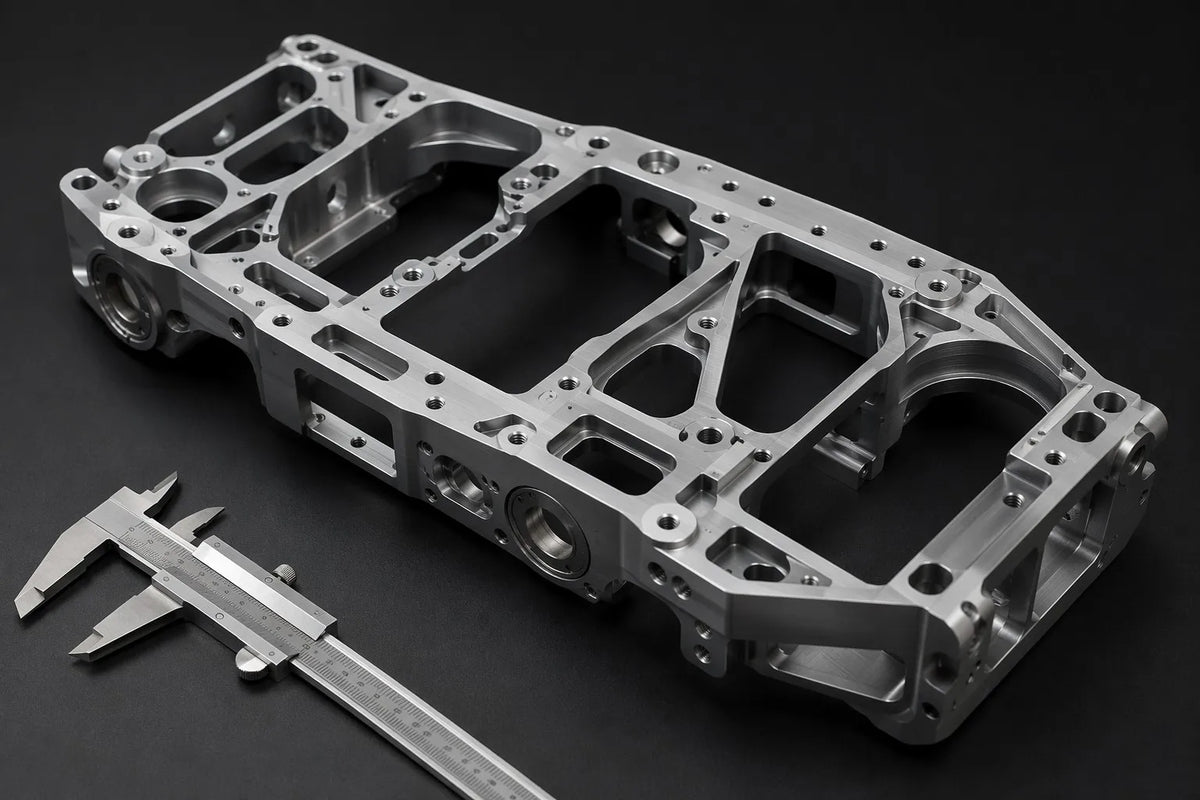
CNC machining for robot chassis frames requires selecting the optimal material for stiffness, weight, and cost. For most robotics applications, Aluminum 6061-T6 is the standard workhorse (lowest cost, excellent machinability), while 7075-T6 provides 82% more yield strength for high-stress frames, and carbon fiber offers the ultimate weight reduction at 5–10× the cost. Alloyer machines all five materials with 72-hour delivery, helping you choose and prototype the right chassis material for your specific application.

Key Things to Know
- Aluminum 6061-T6 is the cost-performance baseline: With a yield strength of 276 MPa at only 2.70 g/cm³, it offers the best machinability and lowest raw material cost — ideal for prototype frames and low-stress chassis where budgets are tight.
- 7075-T6 nearly doubles the strength of 6061: At 503 MPa yield strength, it's the choice for combat robots, drone arms, and high-impact legged platforms. It costs ~50% more but can carry 82% higher loads.
- Carbon fiber wins on weight, not necessarily on machining cost: At 1.55 g/cm³ and 600+ MPa tensile strength, it's 42% lighter than aluminum — but requires diamond-coated tooling and dust extraction, pushing total CNC cost to ~12× 6061-T6.
- PEEK bridges the gap between plastic and metal: At 1.30 g/cm³ and 100 MPa yield, it's the lightest structural option and electrically insulating — ideal for research platforms where sensor isolation matters.
- Every chassis material demands different machining strategies: 6061 runs at high feeds/speeds with standard carbide; 7075 requires reduced feeds to prevent tool wear; carbon fiber needs diamond tooling; titanium demands low-RPM, high-torque cutting; PEEK requires stress-relief annealing before finish passes.
Al 6061-T6: The Workhorse
Properties
Density: 2.70 g/cm³ | Yield Strength: 276 MPa | Elastic Modulus: 68.9 GPa | Hardness: 95 HB (ASTM B308/B308M).
Best For
Entry-level chassis frames, university competition robots (FIRST, VEX), warehouse AMR structural plates, drone landing gear, and any application where cost-per-frame must stay under $50.
CNC Considerations
Excellent machinability. Standard carbide tooling at 10,000–18,000 RPM with 1,500–3,000 mm/min feed rates. No special coolant required — standard water-soluble emulsion is sufficient. Achieves Ra 1.6 μm as-machined, or Ra 0.8 μm with a finishing pass. Type II anodizing adds $2–5 per part for color options.Cost
1.0x baseline. 3-5 day lead time. Raw material ~$4–6/kg. A typical 300 × 200 × 10 mm chassis plate costs $25–45 to machine (1 pc).
Al 7075-T6: High-Strength Aluminum
Properties
Density: 2.81 g/cm³ | Yield Strength: 503 MPa | Elastic Modulus: 71.7 GPa | Hardness: 150 HB (ASTM B211).
Best For
Combat robot (BattleBots) armor and frames, quadruped robot leg links, humanoid joint housings, drone motor mounts, and any chassis that absorbs repeated impact or carries 50+ kg payloads.
CNC Considerations
Good machinability — tougher than 6061, requiring 15–20% lower feed rates to prevent built-up edge on carbide tools. Recommended: 8,000–14,000 RPM with 1,000–2,000 mm/min feeds. Hardcoat anodizing (Type III) is strongly recommended for wear surfaces — adds 2–3 days to lead time but provides 60–70 HRC surface hardness.Cost
1.5x vs 6061-T6. 5-7 day lead time (7-9 days with Type III hardcoat). Raw material ~$7–10/kg. A typical chassis plate costs $40–75 (1 pc).
Carbon Fiber (CFRP): Ultimate Lightweight
Properties
Density: 1.55 g/cm³ | Tensile Strength: 600–800 MPa (fiber direction) | Elastic Modulus: 70 GPa (tensile) | Layup-dependent (ASTM D3039).
Best For
Aerial drone frames, lightweight competition robot chassis, research exoskeleton links, and any application where every gram saved translates directly to longer battery life or higher payload.
CNC Considerations
Special machinability — requires diamond-coated or PCD (polycrystalline diamond) tooling. Carbon fiber dust is conductive and abrasive; dedicated dust extraction with HEPA filtration is mandatory. Delamination at hole exits is the primary failure mode — Alloyer uses sacrificial backing plates and peck-drilling cycles. No coolant (dry machining only). Achieves Ra 1.6–3.2 μm with some fiber pullout visible.Cost
12.0x vs 6061-T6. 7-12 day lead time. Raw material ~$30–80/kg (prepreg sheet). A typical chassis plate costs $120–300 (1 pc). Cost is dominated by tooling wear and slower cycle times, not material price.
PEEK: High-Performance Polymer
Properties
Density: 1.30 g/cm³ | Yield Strength: 90–100 MPa | Elastic Modulus: 3.6 GPa | Continuous service temperature: 250°C (ASTM D638).
Best For
Electrically insulating sensor mounts, research robot frames requiring non-magnetic materials, chemical-resistant chassis for laboratory automation, and lightweight structural links that must survive autoclave sterilization.
CNC Considerations
Fair machinability — PEEK is prone to stress relief warping and surface melting if machined too aggressively. Alloyer stress-relief anneals PEEK blanks before machining and limits cutting temperatures with compressed air cooling. Recommended: 6,000–10,000 RPM with 500–1,000 mm/min feeds, using sharp polished carbide tools. Achieves Ra 0.8–1.6 μm with proper feeds.Cost
15.0x vs 6061-T6. 5-7 day lead time (includes annealing). Raw material ~$80–150/kg. A typical chassis plate costs $150–400 (1 pc). Cost is dominated by material price and slow machining speeds.
Ti-6Al-4V (Grade 5): Extreme-Duty
Properties
Density: 4.43 g/cm³ | Yield Strength: 880 MPa | Elastic Modulus: 113.8 GPa | Hardness: 36 HRC (ASTM B348).
Best For
Critical high-stress chassis joints, bionic hip/knee structural nodes, space-constrained frames where smaller cross-sections must carry maximum load, and any chassis that must survive >10⁷ load cycles without fatigue failure.
CNC Considerations
Poor machinability — low thermal conductivity causes heat buildup at the cutting edge, accelerating tool wear. Requires low RPM (50–100 m/min surface speed), high-torque spindles, and high-pressure coolant. Carbide tools with TiAlN coating are standard. Typical feeds: 100–300 mm/min. Titanium work-hardens if the tool rubs instead of cuts — Alloyer programs aggressive chip loads (0.05–0.10 mm/tooth) to ensure the tool stays in the cutting zone.Cost
8.0x vs 6061-T6. 7-10 day lead time. Raw material ~$40–60/kg. A typical chassis plate costs $200–500 (1 pc). Cost is dominated by slow cycle times (3–5× aluminum) and tooling consumption.
Material Comparison Table
| Material | Density (g/cm³) | Yield Strength | Specific Strength (MPa·cm³/g) | Machinability | Cost Index* | Best For |
|---|---|---|---|---|---|---|
| Al 6061-T6 | 2.70 | 276 MPa | 102 | Excellent | 1.0x | Budget builds, prototypes, education |
| Al 7075-T6 | 2.81 | 503 MPa | 179 | Good | 1.5x | Combat robots, impact-loaded frames |
| Carbon Fiber | 1.55 | 600+ MPa | 387+ | Special | 12.0x | Drone frames, ultra-lightweight chassis |
| PEEK | 1.30 | 100 MPa | 77 | Fair | 15.0x | Insulated frames, research platforms |
| Ti-6Al-4V | 4.43 | 880 MPa | 199 | Poor | 8.0x | Critical joints, high-cycle fatigue areas |
DFM Tips for Robot Chassis Frames
1. Design Pocketing for Stiffness, Not Just Weight Reduction
When removing material to save weight, maintain a rib pattern with ribs oriented along the primary load paths. Ribs should be ≥3 mm wide and spaced ≤50 mm apart. Random pocketing that ignores the load path can reduce bending stiffness by 40% for the same weight savings.
2. Plan Hole Locations for Multi-Sided Machining
If your chassis requires precision bores on multiple faces, group all features accessible from Face A into one setup and Face B into a second. Alloyer's 5-axis machining can reach 5 of 6 faces in a single setup, saving ~30% on fixture costs and improving true position tolerance by eliminating re-clamping errors.
3. Avoid Thin-Wall Sections at Frame Corners
Chassis corners experience the highest stress concentrations during impacts. Maintain a minimum wall thickness of 3 mm at corner radii and 1.5 mm in flat sections. If your design requires <1.5 mm walls for weight savings, switch from 6061-T6 to 7075-T6 — the 82% strength gain compensates for the thinner section.
4. Specify Tapped Holes with Adequate Thread Engagement
For aluminum frame threads (M3–M6), design for a minimum thread engagement of 2× the bolt diameter (e.g., 6 mm engagement for an M3 screw). This prevents stripping under dynamic robot loads. For through-holes in carbon fiber, use press-fit threaded inserts — never tap directly into CFRP.
5. Add Datum Features for Assembly Alignment
Machine two precision dowel-pin holes (H7 tolerance, ±0.01 mm position) on each chassis plate. These serve as reference datums during assembly, ensuring motor mounts and sensor brackets bolt on with consistent alignment — critical when swapping parts mid-competition.
FAQ
Q: Which material gives the best strength-to-cost ratio for a first prototype chassis?
Aluminum 6061-T6. At ~$25–45 per machined frame plate with 3-5 day lead time, it's the fastest, cheapest way to validate your chassis geometry. If your prototype survives testing, upgrade to 7075-T6 for the production frame — the CAD file stays identical; only the material spec changes.Q: How much weight can I save by switching from 6061-T6 to carbon fiber?
A CFRP chassis frame is ~42% lighter than an equivalent-stiffness 6061-T6 frame (1.55 vs 2.70 g/cm³). However, the stiffness-to-weight advantage is directional — carbon fiber is 3–5× stiffer in the fiber direction but ~10× less stiff in the transverse direction. For multi-axial loads (common in robot chassis), expect 25–35% net weight savings after accounting for the necessary laminate optimization.
Q: Can Alloyer machine a monolithic chassis frame with integrated motor mounts?
Yes. Our 5-axis CNC centers can machine a single billet of 6061-T6 or 7075-T6 into a complete chassis with integrated motor mounts, bearing bores (H7 tolerance), and threaded mounting points — eliminating the need for bolt-on motor brackets and the associated assembly tolerance stack. Typical lead time is 5-7 days for a monolithic frame up to 500 × 300 × 80 mm.
Q: When does titanium make economic sense for a robot chassis?
Titanium (Ti-6Al-4V) is justified when: (a) the chassis joint must survive >10⁷ load cycles without fatigue cracking, (b) the frame operates in a corrosive environment (saltwater, chemical exposure) where aluminum would corrode, or (c) space constraints mean a smaller titanium cross-section must carry the same load as a larger aluminum part. For general-purpose robot frames, 7075-T6 provides 90% of the strength at 1/5 the cost.
Q: How does surface finish affect chassis fatigue life?
Surface finish directly impacts fatigue life. A frame with Ra 3.2 μm as-machined finish has ~20% lower fatigue endurance than one with Ra 0.8 μm, because surface micro-grooves act as stress risers. For high-cycle chassis joints, Alloyer recommends Ra 0.8 μm on all load-bearing surfaces and shot peening after machining to introduce compressive surface stress, which can double fatigue life in 7075-T6 components.
More from Alloyer Blog
Ready to machine your robot chassis frame?
Upload your CAD to Alloyer's AI engine for an instant quote with free DFM review. Standard AL 6061 parts start from $8.99, and we machine all five materials covered in this guide with 72-hour delivery on aluminum prototypes.
Upload CAD & Get Quote →