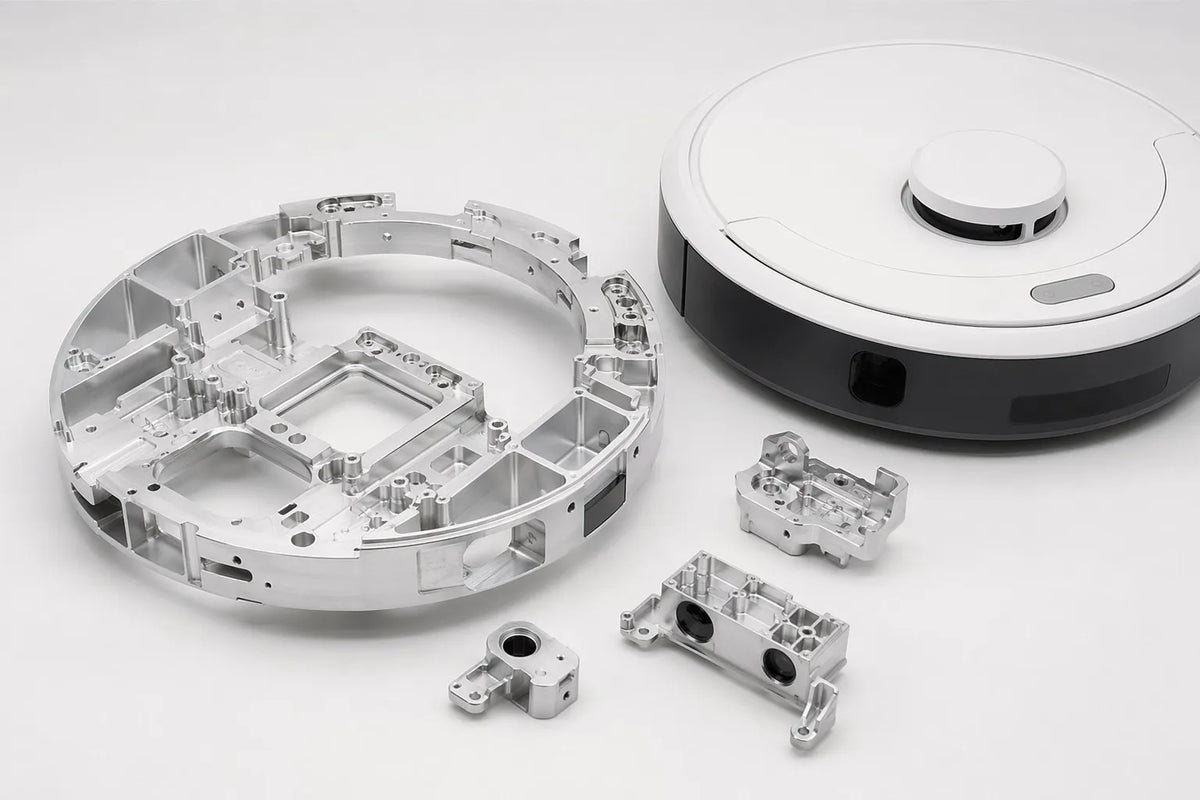
CNC machining for consumer and home service robots is the precision manufacturing process of producing structural chassis frames, sensor mounts, drive-train brackets, and enclosure tooling for mass-market robots including vacuum cleaners, lawn mowers, window washers, and domestic assistant platforms. Alloyer specializes in cost-optimized CNC prototyping for consumer robotics startups, offering 72-hour delivery and 1-piece prototyping to help hardware teams validate designs before committing to injection-molding tooling.

Key Things to Know About CNC Machining for Consumer Robots
- Cost-Optimized Materials: Aluminum 6061-T6 is the workhorse of consumer robotics, offering excellent machinability at the lowest material cost. For non-structural housings, ABS or POM can reduce BOM cost by 30–40% versus all-aluminum designs.
- Bridge-to-Injection-Molding Strategy: CNC is the ideal bridge manufacturing process. Use 1-piece CNC prototypes to validate geometry in 72 hours, then transition to injection molding for volumes above 5,000 units — Alloyer supports both workflows.
- Sensor Integration Precision: Consumer robots rely on LiDAR, IR, and cliff sensors that require flat mounting surfaces within ±0.05 mm for reliable operation across millions of cleaning/mowing cycles.
- Aesthetic and Functional Finishes: Consumer products demand cosmetic quality. Type II bright anodizing and bead blasting provide premium visual finishes that differentiate your robot in a retail or e-commerce environment.
- Weight Constraints for Battery Life: Every gram saved in the chassis extends runtime. CNC pocketing can remove up to 70% of material mass from non-load-bearing regions without compromising structural integrity.
Why Consumer Robots Demand Specialized CNC Machining
Unlike industrial robots designed for factory floors, consumer robots operate in uncontrolled environments — homes with pets, children, stairs, and liquid spills. The manufacturing strategy must balance cost, durability, and aesthetic quality simultaneously.
Cost Sensitivity and Design Validation
Consumer robotics operates on razor-thin margins. A \\$300 robot vacuum cannot afford the material costs of an industrial collaborative robot. This makes the rapid prototyping capabilities of CNC machining critical — hardware teams need to validate a dozen design iterations in the actual production material (e.g., Aluminum 6061-T6 or POM) before committing to a \\$50,000 injection mold. Alloyer's 72-hour delivery and 1-piece minimum order enable teams to test physical hardware daily, compressing the typical 8-week validation cycle into 2 weeks.
Aesthetic Integration of Structural Components
The external body panels of a consumer robot define its brand identity and must be visually flawless. CNC-machined aluminum structural frames often serve double duty as both a load-bearing skeleton and a visible component of the robot's exterior. This requires careful selection of surface finishes — bead blasting followed by Type II anodizing produces a premium, fingerprint-resistant matte surface that survives years of handling without scratching.
Rapid Scalability from Prototype to Production
Consumer robot startups typically follow a scale-up path: 1–10 units (CNC prototypes) → 100–1,000 units (CNC low-volume production) → 5,000+ units (injection molding + CNC for precision inserts). Alloyer supports the full transition — machining the initial prototypes, scaling to production batches, and supplying the precision mold inserts for the injection-molding tool.
Material Properties for Consumer Robotics Components
| Material | Density (g/cm³) | Yield Strength (MPa) | Machinability | Cost Index* | Consumer Robot Application |
|---|---|---|---|---|---|
| Al 6061-T6 | 2.70 | 276 | Excellent | 1.0x | Chassis frames, motor mounts, bumper beams |
| POM (Delrin) | 1.41 | 65 | Excellent | 0.8x | Gears, bushings, brush-roller brackets |
| ABS (CNC Grade) | 1.05 | 45 | Excellent | 0.4x | Enclosure prototypes, dust bins, bumpers |
| Al 7075-T6 | 2.81 | 503 | Good | 1.5x | High-impact corner bumpers, hinge pins |
| Polycarbonate (PC) | 1.20 | 65 | Good | 0.5x | Transparent sensor windows, LiDAR covers |
Critical Components: CNC Requirements
1. Main Chassis Frame
Function: The structural spine of the robot, mounting the drive motors, battery, and cleaning/mowing mechanism. Material: Al 6061-T6 (standard) or ABS (low-cost prototypes). Tolerance: ±0.05 mm for motor mount holes; ±0.10 mm for general pocketing. Surface Finish: Ra 1.6 μm + Type II anodize (silver or matte black). CNC Challenges: Machining large, thin-walled (1.5 mm minimum) chassis plates with extensive lightweighting pockets. Alloyer uses vacuum workholding and high-feed milling strategies to maintain flatness within 0.10 mm over spans up to 400 mm, preventing warping that would cause wheel misalignment.2. Sensor and Camera Mounts
Function: Provide rigid, vibration-dampened platforms for the LiDAR turret, IR cliff sensors, and obstacle-avoidance cameras. Material: Aluminum 6061-T6 or POM (for vibration isolation). Tolerance: Angular alignment within ±0.05°; flatness within 0.03 mm on mounting faces. Surface Finish: Ra 1.6 μm + matte black anodize (to prevent IR reflections that would confuse cliff sensors). CNC Challenges: Maintaining precise angular relationships across multiple sensor mounting planes in a single setup. Alloyer uses 5-axis CNC to machine all sensor bores in one operation, eliminating cumulative alignment errors from multiple 3-axis setups.3. Brush-Roller and Intake Brackets
Function: Mount the rotating brush-roller assembly that agitates debris into the suction path. Material: POM (Delrin) for low-friction bearing surfaces. Tolerance: Bearing bore H7 (+0.015/0 mm); overall bracket length ±0.05 mm. Surface Finish: Ra 0.8 μm on bearing journals. CNC Challenges: POM's thermal expansion coefficient (~110 × 10⁻⁶ /°C) means bearing clearances must be adjusted for the operating temperature range. Alloyer factors thermal growth into the CAD before machining, ensuring bearings don't seize when the robot motor heats up during extended cleaning cycles.Tolerances & Surface Finishes for Consumer Robotics
| Feature | Standard Tolerance | Required Surface Finish | Consumer Impact |
|---|---|---|---|
| Motor Mount Bores | H7 (+0.021/0 mm) | Ra 1.6 μm | Eliminates motor vibration noise — key for home use |
| Sensor Mounting Faces | Flatness 0.03 mm | Ra 1.6 μm + Matte Black | Prevents sensor misreads and navigation errors |
| Visible Exterior Faces | ±0.15 mm | Ra 1.6 μm + Bead Blast + Anodize | Premium retail-quality appearance |
| Wheel Axle Bores | ±0.02 mm | Ra 0.8 μm | Ensures straight tracking on carpets and hard floors |
DFM Tips for Consumer Robot Parts
1. Design for the Transition to Injection Molding
When designing ribs and bosses for CNC prototypes, use draft angles of ≥1.5° on vertical walls. This ensures the same part geometry can transition directly to injection molding tooling without a complete redesign of the CAD model.
2. Optimize Wall Thickness for Cost and Stiffness
For aluminum chassis plates, maintain a nominal wall thickness of 1.5–2.0 mm. Thinner walls risk chatter during high-speed machining and may dent if the robot bumps into furniture. For ABS enclosures, a minimum of 2.0 mm provides adequate impact resistance.
3. Standardize Assembly Interfaces
Use a consistent bolt pattern (e.g., M3 on a 25 mm grid) across all chassis plates. This allows you to CNC-machine a family of interchangeable mounting brackets (sensor pods, battery trays, dustbin latches) that bolt to the same chassis, reducing the SKU count and assembly complexity.
4. Include Break-Off Tabs for Handling
Add small (1 × 1 mm) sacrificial tabs at the edges of large, thin chassis plates. These tabs are broken off after anodizing, but during production they provide grip points for the anodizing rack — preventing visible clamp marks on cosmetic surfaces.
Cost & Lead Time Reference
| Material | Typical Lead Time | Relative Cost | Min Qty | Recommended Use |
|---|---|---|---|---|
| Al 6061-T6 | 3-5 days | 1.0x | 1 pc | |
| Al 7075-T6 | 5-7 days | 1.5x | 1 pc | |
| POM (Delrin) | 3-5 days | 0.8x | 1 pc | |
| ABS (CNC Grade) | 3-5 days | 0.4x | 1 pc | |
| Polycarbonate | 3-5 days | 0.5x | 1 pc |
Frequently Asked Questions
Q: Should I CNC machine or 3D print my first consumer robot prototype?
For structural and motor-mounting parts, CNC machining in Aluminum 6061-T6 is superior. It provides the actual stiffness and thermal properties of the production material, which 3D-printed PLA or resin cannot replicate. For cosmetic enclosure shells, 3D printing is acceptable for form-factor testing. Alloyer recommends CNC for 80% of structural parts and 3D printing for the remaining 20% in early-stage prototyping.
Q: How do I reduce CNC costs when producing 500+ units of a consumer robot chassis?
Three strategies: (1) Switch from 7075-T6 to 6061-T6 for all parts that don't experience high cyclic loads — this saves ~33% on material cost. (2) Standardize internal radii to ≥3 mm to allow processing with faster, cheaper 6 mm tools. (3) Combine multiple small brackets into a single monolithic part machined in one 5-axis setup, eliminating assembly labor and part-count overhead.
Q: Can Alloyer machine the transparent sensor windows for my LiDAR turret?
Yes. We machine polycarbonate (PC) to optical clarity with diamond-tool finishing, achieving a haze level below 3%. Critical applications (e.g., LiDAR) require an additional vapor-polishing step, which we coordinate with our post-processing partners.
Q: How fast can I iterate between design changes during the prototyping phase?
Alloyer's standard 72-hour delivery means you can submit a revised CAD file on Monday, receive the machined part on Thursday, install it, and submit the next revision on Friday. Hardware teams typically complete 3–5 full design-spins per month using this workflow, compressing a 3-month prototyping cycle into approximately 4 weeks.
More from Alloyer Blog
Ready to prototype your consumer robot?
Upload your CAD files to Alloyer's AI engine for an instant price quote and free DFM review. Standard AL 6061 parts start from $8.99, and we accept 1-piece prototyping orders with 72-hour delivery.
Upload CAD & Get Quote →