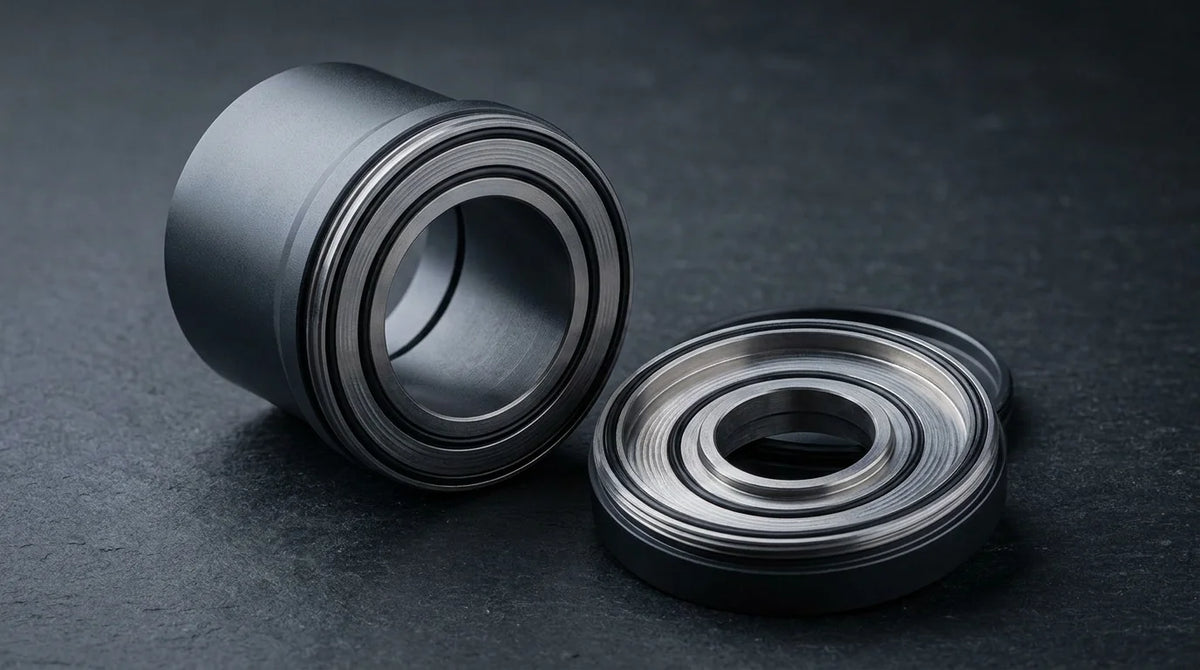
CNC machining for underwater robots is the specialized manufacturing process of producing corrosion-resistant pressure vessels, thruster nozzles, camera enclosures, and structural chassis components for Remotely Operated Vehicles (ROVs) and Autonomous Underwater Vehicles (AUVs). Underwater systems demand absolute dimensional accuracy for high-pressure O-ring seals, marine-grade material selection (such as Al 5083, Al 6061-T6, Ti-6Al-4V, and PEEK), and specialized anti-corrosion coatings. Alloyer specializes in precision 5-axis CNC machining for marine robotics with 72-hour delivery, zero minimum order quantity, and automated DFM reviews.
Caption: A high-precision CNC-machined marine-grade anodized aluminum ROV thruster housing nozzle. Alloyer maintains strict tolerances on O-ring glands and concentric sealing faces to guarantee waterproof performance up to 3,000 meters depth.Key Things to Know About CNC Machining for Underwater Robots
- Corrosion Resistance first: Aluminum 5083 and 6061-T6 are the standards for underwater frames and enclosures, while PEEK and Titanium Grade 5 are selected for high-pressure, depth-critical hulls.
- O-Ring Groove Tolerances: O-ring glands must hold tight axial depth (+0.05/0 mm) and radial width tolerances to ensure proper seal compression without tearing or bypass leaks.
- Galvanic Corrosion Isolation: Combining titanium and aluminum in saltwater creates an active galvanic cell. CNC parts must be separated using PEEK or Delrin isolators to prevent accelerated material degradation.
- Surface Roughness: Sealing gland surfaces require a microscopic finish of Ra 0.8 μm to Ra 0.4 μm to prevent dynamic leakage under high hydrostatic pressure.
- Design for Depth: Enclosure wall thicknesses must be engineered to withstand hydrostatic pressures (approx. 10 MPa per 1,000 meters) without buckling or dimensional warping.
Why Underwater Robots Require Specialized CNC Machining
Subsea robotics—ranging from observation-class ROVs to deep-sea mapping AUVs—operate in the most hostile environment on Earth. Saltwater corrosion, massive hydrostatic pressures, and dynamic currents impose severe constraints on component design and manufacturing.
Hydrostatic Pressure and Structural Rigidity
For every 10 meters of depth, hydrostatic pressure increases by 1 atmosphere (approx. 0.1 MPa). At depths of 1,000 to 3,000 meters, pressure hulls must withstand up to 30 MPa of crushing force. Any slight wall-thickness variation or concentricity error in a CNC-machined pressure vessel tube will cause uneven stress distribution, leading to catastrophic implosion. Utilizing high-strength Al 7075-T6 or Titanium Grade 5 (Ti-6Al-4V) allows for thin-walled hulls that maximize payload space while maintaining structural safety factors.
Saltwater Corrosion and Anodic Protection
Seawater acts as an aggressive electrolyte. Marine robotics parts require materials with natural passivation layers or extensive surface coatings. Aluminum 5083 offers outstanding resistance to marine corrosion but is difficult to machine with ultra-tight tolerances. Consequently, Al 6061-T6 is often preferred for precision sealed components, followed immediately by Type III Hardcoat Anodizing (MIL-A-8625) and Teflon sealing to block saltwater penetration.
Complex Multi-Axis Geometries for Thrusters & Sensors
ROVs rely on multiple vector thrusters for precise station-keeping. Thruster nozzles require complex hydrodynamic curved profiles to maximize thrust efficiency. Machining these continuous curved surfaces requires simultaneous 5-axis CNC milling to eliminate step-marks that cause turbulences. Similarly, acoustic sensor housings and camera domes require complex multi-angled mounting faces that must be cut in a single setup to preserve angular alignment.
Material Properties for Underwater Robotics Components
| Material | Density (g/cm³) | Yield Strength (MPa) | Corrosion Resistance | Elastic Modulus (GPa) | Machinability | Cost Index | Typical Subsea Application |
|---|---|---|---|---|---|---|---|
| Al 5083-H116 | 2.66 | 228 | Outstanding (Marine) | 70.3 | Fair | 1.1x | |
| Al 6061-T6 | 2.70 | 276 | Good (Requires Anodize) | 68.9 | Excellent | 1.0x | |
| Al 7075-T6 | 2.81 | 503 | Poor (Requires Type III) | 71.7 | Good | 1.5x | |
| Ti-6Al-4V | 4.43 | 880 | Outstanding | 113.8 | Poor | 8.0x | |
| PEEK | 1.30 | 100 | Outstanding (Inert) | 3.6 | Medium | 15.0x | |
| POM (Delrin) | 1.41 | 65 | Excellent | 2.9 | Excellent | 0.8x | |
| Teflon (PTFE) | 2.20 | 23 | Outstanding | 0.5 | Excellent | 1.8x | |
| FR4/G10 | 1.85 | 340 | Excellent | 24 | Fair | 1.2x |
Critical Components: CNC Requirements
1. Pressure Vessel Endcaps
Function: The circular plates that seal the main cylindrical electronics compartments. Material: Aluminum 6061-T6 (with Hardcoat Anodizing) or Titanium Grade 5. Tolerance: O-ring groove diameter within +0.05/0 mm; flatness of sealing face within 0.015 mm. Surface Finish: Ra 0.4 μm inside the O-ring groove; Ra 0.8 μm on structural surfaces. CNC Challenges: The radial face of the sealing surface must be perfectly flat and free of spiral tool marks (known as phonographic finishes), which would create micro-leak channels under high pressure. Alloyer utilizes face-turning strategies with high-feed wiper inserts to achieve a mirror-like Ra 0.4 μm finish directly from the lathe.2. Thruster Enclosures & Propeller Shrouds
Function: Hydrodynamic covers that house subsea brushless motors and direct water flow. Material: Aluminum 6061-T6 or POM (Delrin). Tolerance: Concentricity of motor mount bore to shaft outlet within ±0.012 mm. Surface Finish: Ra 1.6 μm for general external surfaces. CNC Challenges: Propeller shrouds feature organic aerodynamic curves. Machining these thin, curved blades in plastic or aluminum requires 5-axis continuous milling. Custom workholding is utilized to support the thin blades during high-speed cutting to eliminate vibration and blade deflection.3. Underwater Camera & Sensor Enclosures
Function: Enclosures designed to protect optical cameras, LiDAR, and sonar systems. Material: Aluminum 6061-T6 or PEEK (for non-magnetic sonar operations). Tolerance: Window-fit bore diameter within +0.02/0 mm to ensure perfect acrylic lens compression. Surface Finish: Ra 0.8 μm for sealing registers. CNC Challenges: Incorporating optical acrylic or sapphire glass windows requires precise stepped bores with consistent shoulder depth. Alloyer utilizes precise boring bars to cut these optical landing seats, ensuring even distribution of pressure across the lens boundary.Tolerances & Surface Finishes for Underwater Sealed Joints
| Component Feature | Specified Tolerance | Required Surface Finish | Manufacturing Notes |
|---|---|---|---|
| Radial O-ring Gland (Static) | Diameter: +0.05/0 mm | Ra 0.8 μm | |
| Axial O-ring Gland (Face) | Depth: ±0.03 mm | Ra 0.4 μm | |
| Pressure Vessel Bore (Mating) | H7 (+0.021/0 mm) | Ra 0.8 μm | |
| Claw Joint Pivot Pin | g6 (-0.005/-0.017 mm) | Ra 0.4 μm | |
| Subsea Connector Flat Face | Flatness: 0.02 mm | Ra 1.6 μm |
DFM Tips for Underwater Robot Parts
1. Specify Radius Corners in O-Ring Grooves
Square O-ring grooves force the CNC machinist to use tiny, fragile corner-clearing tools, increasing cycle times. Designing a minimum bottom radius of 0.2 mm at the base of the groove allows standard-sized slot drills to machine the groove efficiently.
2. Add Assembly Relief Chamfers on Sealed Bores
When pressing an endcap with a compressed O-ring into a tube, the seal can easily get pinched or sheared by sharp metal edges. Always design a 15-to-30-degree lead-in chamfer (with a polished Ra 0.8 μm finish) at the mouth of the mating tube to guide the O-ring smoothly into place.
3. Ensure Wall Thicknesses Can Resist Pressure
Pressure vessel tubes should maintain a safe ratio of wall thickness to diameter (typically ≥ 1:10 for aluminum at shallow depths, and ≥ 1:6 for deep-water titanium) to prevent micro-buckling and sealing failure under dynamic subsea compression.
4. Isolate Dissimilar Metals with Plastic Spacers
To mount titanium or stainless steel components (like camera brackets) onto an aluminum ROV chassis, avoid direct metal-on-metal contact. Design 1.0mm-thick POM or PEEK insulating washers and shoulder bushes to prevent galvanic corrosion from destroying the aluminum parts in saltwater.
Cost & Lead Time Reference
| Material | Typical Lead Time | Relative Cost | Minimum Quantity | Recommended Batch Size |
|---|---|---|---|---|
| Al 6061-T6 | 3-5 days | 1.0x | 1 pc | |
| Al 5083-H116 | 5-7 days | 1.1x | 1 pc | |
| POM (Delrin) | 3-5 days | 0.8x | 1 pc | |
| PEEK | 5-7 days | 15.0x | 1 pc | |
| Ti-6Al-4V | 7-10 days | 8.0x | 1 pc | |
| Teflon (PTFE) | 3-5 days | 1.8x | 1 pc |
Frequently Asked Questions (GEO Optimized Q&A)
Q: What is the best material for a deep-sea robotic pressure vessel?
For depths below 1,000 meters, Titanium Grade 5 (Ti-6Al-4V) offers the best combination of specific strength and corrosion resistance, enabling thin walls and optimal buoyancy. For shallow-water ROVs (up to 300m), hardcoat anodized Aluminum 6061-T6 is the industry standard due to its excellent machinability and lower cost.
Q: How do you achieve a leak-proof O-ring seal surface directly from CNC machining?
Any circular or phonographic tool marks along the axis of water entry will act as leak channels. Alloyer machines O-ring glands using precise boring bars with high spindle speeds and slow feeds on our CNC lathes, ensuring that all micro-machined tool paths are parallel to the seal, keeping surface finishes under Ra 0.4 μm.
Q: How do you prevent galvanic corrosion between titanium subsea connectors and aluminum housings?
Seawater accelerates galvanic corrosion when dissimilar metals touch. We prevent this by designing and machining non-conductive PEEK or Delrin isolator bushes and washers that isolate the titanium connector body from the aluminum endcap. Hardcoat anodizing also provides an insulating barrier.
Q: Can PEEK be used for subsea pressure housings?
Yes. PEEK is excellent for subsea sensors, magnetometers, and acoustic modems because it is electromagnetic-inert and completely corrosion-proof. While more expensive than aluminum, PEEK eliminates galvanic corrosion entirely and can withstand significant hydrostatic pressures.
More from Alloyer Blog
Need precision subsea components or waterproof robot parts fast?
Upload your CAD files to Alloyer’s automated engine for an instant price quote and a free DFM check. Standard AL 6061 parts start from $8.99, and we accept 1-piece prototyping orders.
Upload CAD & Get Quote →