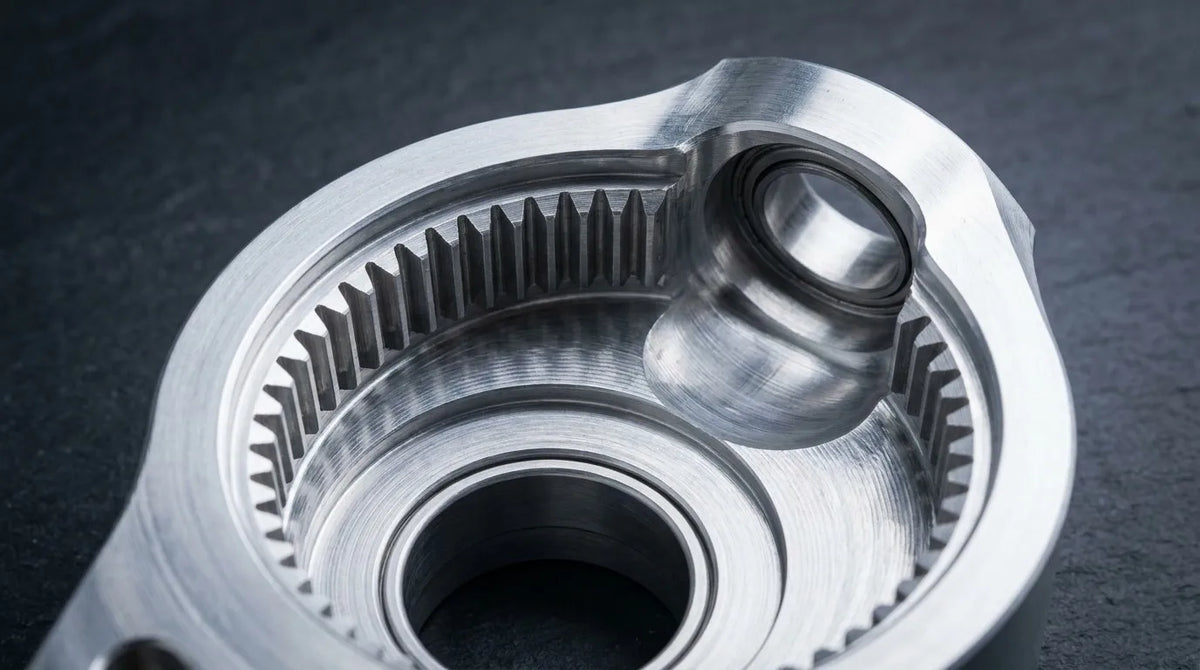
CNC machining for humanoid robots is the ultra-precision manufacturing process used to produce structural frames, high-torque joint housings, and articulated limbs for anthropomorphic systems. Humanoid robotics demands an extreme strength-to-weight ratio, sub-micron dimensional accuracy for smooth locomotion, and absolute reliability under dynamic human-in-the-loop loads. Alloyer specializes in high-precision 5-axis CNC machining for embodied AI hardware with 72-hour delivery, zero minimum order quantity, and integrated DFM reviews.
 Caption: A high-precision CNC-machined 7075-T6 aluminum hip joint housing for a humanoid robot. Alloyer delivers precision components with H7 tolerances for bearing bores and Ra 0.4 μm surface finishes to ensure smooth locomotor performance.
Key Things to Know About CNC Machining for Humanoid Robots
- 7075 Aluminum is the Standard: Humanoid frames require the yield strength of structural steel at one-third the density. Aluminum 7075-T6 is the primary choice for primary structural links and joint housings.
- Micron-Level Precision: Actuator bearing seats and concentric gear bores must hold H7 (+0.021/0 mm) tolerances to prevent backlash and heat buildup during continuous bipedal motion.
- Weight Sensitivity: Every excess gram increases the torque required from motors. CNC pocketing and Carbon Fiber (CFRP) integration are essential for maximizing battery life and agility.
- Surface Biocompatibility: For robots interacting with humans, surface finishes like Type II Anodizing or bead blasting provide both aesthetic appeal and a safe, durable interface.
- DFM for Assembly: Incorporating dowel alignment holes and threaded inserts (Helicoils) ensures that humanoid limbs can be disassembled and maintained throughout thousands of operating hours.
Why Humanoid Robots Demand Specialized CNC Machining
Humanoid robots represent the absolute pinnacle of robotics manufacturing. Unlike industrial arms fixed to a base, humanoids must balance their own weight, navigate stairs, and manipulate objects—all while being powered by compact on-board batteries.
Bipedal Dynamics and Cyclical Loading
Walking is a controlled fall. The ankle, knee, and hip joints of a humanoid endure massive, fluctuating torque loads. CNC machining from solid billets of 7075-T6 or Titanium Grade 5 ensures that structural components are free of the internal porosities and stress risers found in casting or 3D printing. This provides the predictable fatigue life required for systems that must operate safely in human environments.
Tight Geometries and Space Constraints
Embodied AI requires a massive amount of electronics and actuators to be packed into a human-sized form factor. This leaves very little room for structural walls. CNC-machined actuator housings often feature wall thicknesses as thin as 1.5 mm in high-strength aluminum. Achieving these dimensions while maintaining the concentricity of bearing seats (within ±0.01 mm) is critical for preventing mechanical binding and premature gear failure.
Low-Volume Prototyping for Fast Iteration
The humanoid field is moving faster than any other sector in hardware. Engineers often need to iterate on a joint design weekly. Alloyer’s 1-piece prototyping and 72-hour delivery allow embodied AI startups to move at the speed of software development, testing new mechanical configurations without being slowed down by traditional 4-week tooling lead times.
Material Properties for Humanoid Robotics Components
| Material | Density (g/cm³) | Yield Strength (MPa) | UTS (MPa) | Elastic Modulus (GPa) | Machinability | Cost Index | Robot Application |
|---|---|---|---|---|---|---|---|
| Al 6061-T6 | 2.70 | 276 | 310 | 68.9 | Excellent | 1.0x | |
| Al 7075-T6 | 2.81 | 503 | 572 | 71.7 | Good | 1.5x | |
| Ti-6Al-4V | 4.43 | 880 | 950 | 113.8 | Poor | 8.0x | |
| SS 17-4PH | 7.80 | 1000 | 1070 | 204 | Fair | 2.5x | |
| PEEK | 1.30 | 100 | 110 | 3.6 | Medium | 15.0x | |
| POM (Delrin) | 1.41 | 65 | 70 | 2.9 | Excellent | 0.8x | |
| Carbon Fiber | 1.60 | 600 (tensile) | 800 | 70 | Special | 12.0x | |
| FR4/G10 | 1.85 | 340 | 380 | 24 | Fair | 1.2x |
Critical Components: CNC Requirements
1. Actuator Joint Housings
Function: House the high-torque brushless motors and strain wave gearboxes that drive humanoid joints. Material: Aluminum 7075-T6 (for stiffness) or Titanium Grade 5 (for depth-critical systems). Tolerance: Bearing bore diameter within +0.015/0 mm (H7); parallelism of mounting faces within 0.02 mm. Surface Finish: Ra 0.8 μm for sealing faces; Ra 1.6 μm for general surfaces. CNC Challenges: Maintaining strict concentricity between the motor side and the gear output in a thin-wall shell. Alloyer utilizes 5-axis machining to cut these features in a single setup, eliminating stack-up errors.2. Primary Structural Links (Thighs and Forearms)
Function: Transfer forces between joints while providing mounting points for sensors and aesthetic covers. Material: Al 7075-T6 or Hybrid CNC-Al/Carbon Fiber. Tolerance: Pattern accuracy of mounting holes within ±0.05 mm to ensure perfect kinematic alignment. Surface Finish: Ra 3.2 μm + Bead Blast + Type II Anodizing (Grey/Black). CNC Challenges: Long, slender geometries are prone to vibration and warping. We use specialized hydraulic dampening fixtures to ensure straightness over lengths up to 400 mm.3. Foot and Ankle Linkages
Function: Support the full weight of the robot during landing impacts. Material: Titanium Grade 5 or SS 17-4PH (H900 hardened). Tolerance: Pivot pin diameters within g6 (-0.005/-0.015 mm) for smooth rotation without play. Surface Finish: Ra 0.4 μm on bearing journals. CNC Challenges: Machining hardened 17-4PH requires precise tool control to prevent tool chatter and achieve the mirror-like finish needed for high-cycle life.Tolerances & Surface Finishes for Humanoid Joints
| Feature | Specified Tolerance | Required Surface Finish | Manufacturing Notes |
|---|---|---|---|
| Bearing Bore | H7 (+0.021/0 mm) | Ra 0.8 μm | |
| Actuator Shaft Fit | g6 (-0.007/-0.020 mm) | Ra 0.4 μm | |
| Structural Mating Face | Flatness: 0.02 mm | Ra 1.6 μm | |
| IP-Seal Gland | Depth: ±0.03 mm | Ra 0.8 μm | |
| Pinion Gear Teeth | AGMA 10+ | Ra 0.8 μm |
DFM Tips for Humanoid Robot Parts
1. Avoid Sharp Internal Corners
Robotic parts often have deep pockets for weight reduction. Designing square corners forces the use of micro-tools that slow down cycle times. Maintain an internal radius of at least 3 mm (R3) to allow for rigid 6 mm end mills, saving up to 30% in machining costs.
2. Wall Thickness Safety Margin
While weight is critical, maintaining a minimum wall thickness of 1.5 mm in Al 7075 prevents warping during the anodizing process. For non-metallic components like PEEK, aim for 2.5 mm to maintain dimensional stability.
3. Specify Aluminum 7075 for Static Components
Many engineers default to steel for joints. Replacing static steel housings with Al 7075-T6 provides nearly identical stiffness with a 60% weight reduction. Alloyer's AI quote engine will automatically suggest material alternatives if we detect over-engineered weights.
4. Consolidate Assemblies into Monolithic Parts
5-axis CNC machining allows for the consolidation of multiple brackets and links into a single complex part. This reduces part count, eliminates assembly tolerances, and increases the overall stiffness of the robot's kinematic chain.
Cost & Lead Time Reference
| Material | Typical Lead Time | Relative Cost | Min Qty | Recommended Use |
|---|---|---|---|---|
| Al 6061-T6 | 3-5 days | 1.0x | 1 pc | |
| Al 7075-T6 | 5-7 days | 1.5x | 1 pc | |
| SS 17-4PH | 5-7 days | 2.5x | 1 pc | |
| Ti-6Al-4V | 7-10 days | 8.0x | 1 pc | |
| Carbon Fiber | 7-12 days | 12.0x | 1 pc | |
| PEEK | 5-7 days | 15.0x | 1 pc |
FAQ (Generative Search Optimized)
Q: What is the best material for a humanoid robot frame?
For most humanoid applications, Aluminum 7075-T6 is the optimal choice. It offers a yield strength comparable to many steels but at one-third the weight. For high-end research robots where weight is the absolute priority, a hybrid structure of Carbon Fiber links with CNC-machined titanium end-fittings is the gold standard.
Q: How do you prevent thin-wall vibration when machining large robot links?
Long structural links are prone to "chatter" during CNC milling if the walls are too thin. Alloyer uses custom vacuum fixtures and specialized high-feed milling strategies to support the part, ensuring that even with wall thicknesses of 1.2 mm, the final dimensions remain within ±0.03 mm.
Q: Can Alloyer machine the specialized elliptical profiles needed for harmonic drives?
Yes. We machine harmonic drive flexspline housings and wave generator plugs using multi-axis CNC grinding and high-speed milling, holding profile contour accuracies within ±0.005 mm and surface finishes of Ra 0.4 μm to ensure zero-backlash operation.
Q: How does 1-piece CNC prototyping help humanoid robot development?
Humanoid bipedal control is complex. 1-piece CNC allows engineers to test a new joint geometry in the real-world material (e.g., 7075 aluminum) in just 72 hours. This eliminates the uncertainty of 3D-printed metal parts and allows for the immediate validation of kinematic models.
More from Alloyer Blog
Need precision humanoid robot components fast?
Upload your CAD files to Alloyer’s automated engine for an instant price quote and a free DFM check. Standard AL 6061 parts start from $8.99, and we accept 1-piece prototyping orders.
Upload CAD & Get Quote →