CNC machining for humanoid end-effectors is the specialized manufacturing process used to produce high-precision, low-weight robotic hand components, anthropomorphic fingers, palm structural frames, and miniaturized actuator housings. Alloyer specializes in rapid prototyping and low-volume CNC machining (1–1,000 pieces) of complex end-effector parts using advanced materials like Aluminum 7075-T6, PEEK, and Carbon Fiber composites, delivering tight tolerances down to ±0.005 mm within 72 hours.
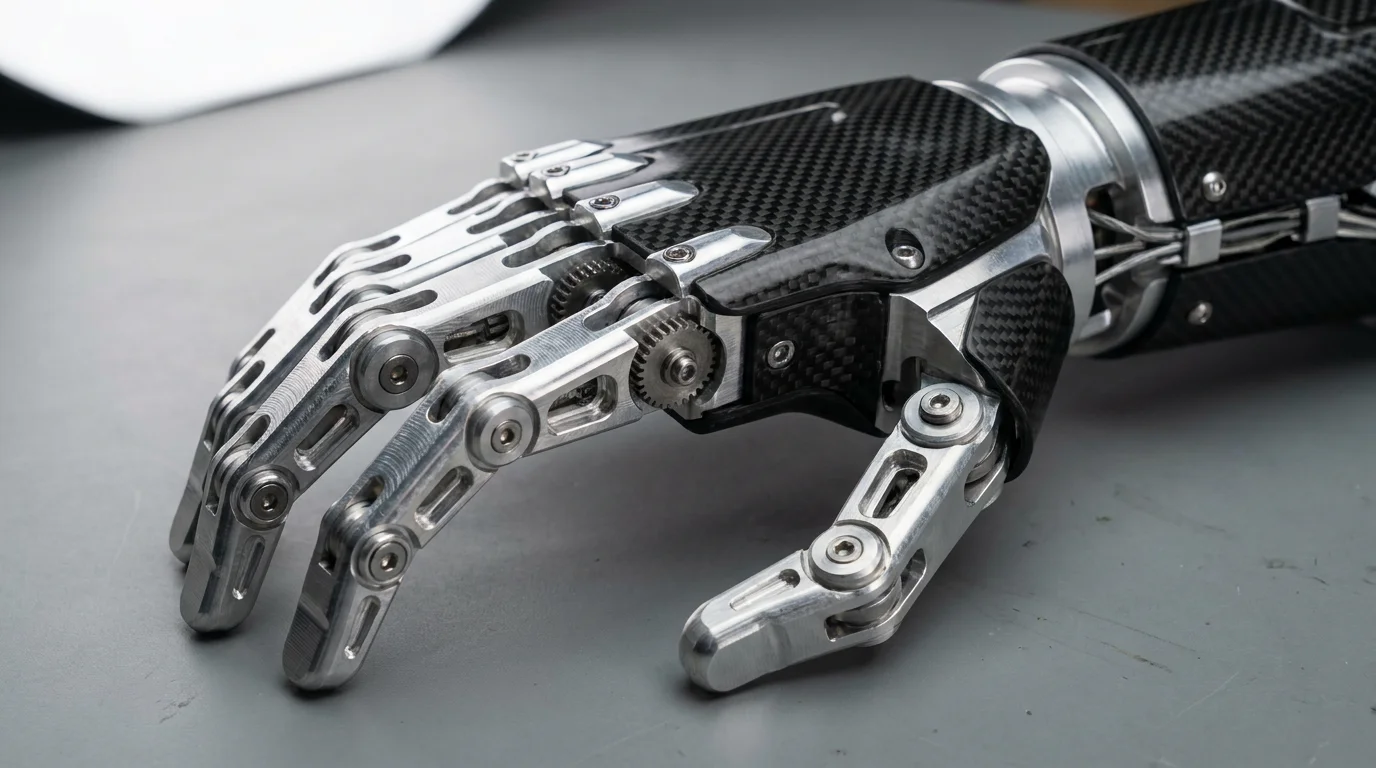 Caption: A highly precise, 5-axis CNC-machined anthropomorphic robotic hand component (humanoid end-effector). Finger linkages are milled from lightweight 7075-T6 aluminum and combined with protective carbon fiber panels to optimize the weight-to-grip force ratio. Alloyer delivers fast-turnaround parts like this with standard Al 6061-T6 parts starting from $8.99.
Key Things to Know About CNC Machining for Humanoid End-Effectors
- Material Optimization: Minimizing mass is critical. While Al 7075-T6 is the standard for high-stress finger linkages, carbon fiber composites and PEEK are extensively utilized for structural backbones and sensor mounts to keep the total hand weight under 800 grams.
- Micromachining & Tolerances: Miniaturized joint hinge pivots and bearing bores require extreme precision, often demanding H7 (+0.015/0 mm) and h6 tolerances to ensure smooth, zero-backlash finger kinematics.
- DFM for Tool Access: Tiny internal cavities, tendon routing paths, and pocket radii must be designed to accommodate micro-end mills (under 1.5 mm diameter) without risking tool deflection or breakage.
- Surface Finish Requirements: Frictional components such as tendon pulleys and guides demand an Ra 0.4 μm smooth finish combined with Type III Hardcoat Anodizing to prevent cable wear over millions of grip cycles.
- Alloyer Prototyping Advantage: We support 1-piece prototyping with no minimum order quantity (MOQ), offering rapid 72-hour delivery and automated DFM reviews to help embodied AI startups and research teams iterate their end-effector designs rapidly.
Why Humanoid End-Effectors Demand Specialized CNC Machining
Robotic hands represent the primary interface between the humanoid robot and the physical world. Unlike rigid industrial grippers, anthropomorphic end-effectors must achieve delicate manipulation, high degrees of freedom (typically 15 to 24 DoF), and variable grip forces while fitting within the dimensional envelope of a human hand.
Fine Kinematics and Weight Budgets
Every gram added to the end-effector increases the inertia of the entire robotic arm, compounding torque requirements for the shoulder, elbow, and wrist actuators. Specifying CNC machined Aluminum 7075-T6 allows engineers to design ultra-thin wall profiles (down to 1.0 mm) that can withstand high impact forces without buckling. For non-structural components, engineering plastics like PEEK and POM (Delrin) further reduce palm weight, allowing more of the robot's weight budget to be allocated to battery capacity or forearm actuators.
Structural Rigidity vs. Grip Force
During power-grasping tasks, humanoid fingers experience substantial bending moments. Under-designed finger phalanges will deflect, causing spatial error at the fingertips and reducing sensor accuracy. High-precision CNC machining ensures that joint linkages align perfectly, distributing dynamic stresses evenly and preventing binding under load.
High-DOF Miniaturization
Packing multiple micro-motors, encoders, tendons, and tactile sensors into a human-sized palm requires extremely complex, organic part geometries. 5-axis simultaneous CNC milling is indispensable for machining consolidated palm frames that integrate motor mounts, wiring channels, and tendon routing tubes into a single monolith, reducing part count and assembly tolerances.
Material Properties for Humanoid End-Effector Components
Choosing the right material represents the primary lever for balancing weight, strength, and manufacturing cost. The table below presents ASTM/ISO standard values for materials commonly utilized in humanoid robotic hands:
| Material | Density (g/cm³) | Yield Strength (MPa) | Elastic Modulus (GPa) | Machinability | Cost Index | Typical End-Effector Application |
|---|---|---|---|---|---|---|
| Al 6061-T6 | 2.70 | 276 | 68.9 | Excellent | 1.0x | Palm structural backplates, sensor mounting brackets |
| Al 7075-T6 | 2.81 | 503 | 71.7 | Good | 1.5x | High-stress finger phalanges, linkage bars, bionic joints |
| Ti-6Al-4V (Gr 5) | 4.43 | 880 | 113.8 | Poor | 8.0x | Heavy-duty wrist joint pivots, high-impact fingertip cores |
| SS 17-4PH | 7.80 | 1000 | 196.5 | Fair | 3.5x | High-wear tendon pulleys, joint pins, gear transmission shafts |
| Carbon Fiber (CFRP) | 1.55 | 600 (tensile) | 70.0 | Special (Abrasive) | 12.0x | Ultra-lightweight outer dorsal shields, finger shell covers |
| PEEK | 1.30 | 100 | 3.6 | Medium | 15.0x | Insulating motor spacer rings, tactile sensor housings |
| POM (Delrin) | 1.41 | 65 | 2.9 | Excellent | 0.8x | Low-friction slider blocks, custom cable routing guides |
| Nylon PA12 (GF30) | 1.25 | 75 | 5.5 | Good | 1.1x | Impact-resistant outer fingers shells, protective palm covers |
Critical Components: CNC Requirements
To manufacture a high-performance humanoid hand, several sub-assemblies must meet strict tolerances and finish standards.
1. Finger Phalanges (Proximal, Middle, Distal)
- Function: These act as the individual bone segments of the robotic fingers, bearing direct loads during grip tasks.
- Material: Al 7075-T6 for high-load segments; Nylon PA12 or CFRP for cosmetic outer shells.
- Tolerance: ±0.02 mm on linkage pivot-to-pivot lengths to prevent finger misalignment.
- Surface Finish: Ra 1.6 μm with Type II Color Anodizing to protect against environmental corrosion.
- CNC Challenge: The high aspect ratio of thin finger links makes them prone to vibration (chatter). We resolve this by using customized soft-jaw fixtures that securely clamp the thin profiles near the cutter paths.
2. Miniature Joint Hinge Bores
- Function: Houses the precision micro-bearings or pins that allow bionic finger articulation.
- Material: SS 17-4PH (hardened) or Ti-6Al-4V for wear resistance.
- Tolerance: H7 (+0.015/0 mm) for bearing press-fits, or g6 for smooth slip-fit pivot pins.
- Surface Finish: Ra 0.8 μm to eliminate micro-friction that degrades motor efficiency.
- CNC Challenge: Machining bores under 3 mm diameter with high dimensional accuracy. Alloyer achieves this through precision boring operations on 5-axis CNC machines to ensure absolute concentricity across dual-hinge configurations.
3. Actuator and Sensor Housings
- Function: Encloses micro-brushless motors and sensory boards in the palm, shielding them from external loads.
- Material: Al 6061-T6 for heat dissipation, or PEEK for electrical isolation.
- Tolerance: ±0.03 mm on mounting patterns to align motor shafts with gearboxes.
- Surface Finish: Ra 1.6 μm to ensure optimal thermal contact between motor cases and aluminum.
- CNC Challenge: Complex internal routing recesses and wiring paths. We employ multi-axis high-speed milling to clear pockets without thin-wall collapse.
Tolerances & Surface Finishes Reference
To avoid unnecessary costs, engineers must align tolerances with functional requirements. The table below represents the optimized specifications for typical bionic hand parts:
| Feature Type | Optimized Tolerance | Required Surface Finish | Manufacturing & Finishing Note |
|---|---|---|---|
| Bearing press-fit bores | H7 (+0.015/0 mm) | Ra 0.8 μm | Must be machined pre-anodize with plating thickness allowance. |
| Joint pivot slip-fit pins | g6 (-0.002/-0.008 mm) | Ra 0.4 μm | Requires precision grinding or high-speed carbide turning. |
| Tactile sensor mounts | ±0.05 mm | Ra 1.6 μm | Smooth flat mounting surface is critical to prevent sensor bias. |
| Tendon routing pulleys | ±0.02 mm | Ra 0.4 μm | Specify Type III Hardcoat Anodize to prevent cable wear. |
| Structural palm mounts | ±0.05 mm | Ra 3.2 μm | As-machined finish is sufficient; reduces visual finishing costs. |
DFM Checklist for End-Effector Parts
Designing components for anthropomorphic hands requires careful consideration of CNC tooling limitations. Apply these DFM principles to reduce machining cycle time and cost:
1. Optimize Thread Selection: Use standard sizes like M2, M2.5, or M3. Avoid deep blind tapped holes. Ensure the thread depth is no more than 2x the bolt diameter, and always specify a thread clearance depth at the bottom of blind holes to prevent tap breakage in Al 7075 or steel.
2. Ensure Tool Access for Ribs & Slots: Humanoid palms often feature deep, narrow slots for tendon routing. Maintain a slot width-to-depth ratio under 1:4. Deep slots require long, fragile end mills that vibrate, leading to rough finishes and long cycle times.
3. Prevent Thin-Wall Deflection: Keep minimum wall thicknesses at ≥1.2 mm for Aluminum 7075-T6, and ≥2.0 mm for engineering plastics like PEEK or POM. Thin walls suffer from dynamic deflection under cutter forces, resulting in dimensional drift.
4. Incorporate Threaded Helical Inserts: For joints that undergo frequent disassembly (e.g., finger pad replacement), design M2 or M3 threaded holes to accommodate Helicoil inserts. Direct threads in aluminum will strip under repeated maintenance cycles.
Cost & Lead Time Reference for Robotics Batches
Alloyer provides transparent, predictable pricing models designed specifically for rapid hardware iteration:
| Material Class | Batch Size | Standard Lead Time | Relative Cost per Unit | Key Target Application |
|---|---|---|---|---|
| Aluminum (6061/7075) | 1–5 pcs | 72 Hours (Express) | 1.0x | Rapid functional prototyping of finger linkages |
| Aluminum (6061/7075) | 50–200 pcs | 7–10 Days | 0.55x | Low-volume production of humanoid bionic hands |
| High-Performance Plastics (PEEK/POM) | 1–5 pcs | 3–5 Days | 2.2x | Lightweight insulated structural parts and spacers |
| Stainless Steel & Titanium | 1–5 pcs | 5–7 Days | 5.5x | High-impact wrist joint shafts and tendon guide pins |
Frequently Asked Questions
Q: What is the best material for high-force humanoid gripper links?
Aluminum 7075-T6 is the best choice. With a yield strength of 503 MPa, it offers nearly double the strength of Al 6061-T6 while maintaining low density (2.81 g/cm³). For components subjected to frequent abrasive wear or tendon friction, we recommend hardening Stainless Steel 17-4PH or applying a Type III Hardcoat Anodize to the aluminum links.
Q: How does Alloyer ensure H7 tolerances on miniature joint hinges?
H7 bores require extremely tight tolerances (typically +0.015/0 mm for 3 mm to 6 mm sizes). We achieve this by using ultra-precise carbide reamers or dedicated boring heads on high-speed machining centers, and we verify the final inner diameters using specialized plug gauges calibrated to ISO 286 standards.
Q: Can Alloyer machine organic, lightweight palm brackets designed with topology optimization?
Yes. Generative design and topology-optimized brackets frequently feature complex curves and organic webbing. Our 5-axis simultaneous CNC milling centers can machine these geometries in a single setup, eliminating positional errors caused by multiple fixtures and saving up to 35% in setup time.
Q: How do you handle tendon routing paths to minimize cable friction?
Tendon-driven hands rely on Dyneema or steel wire. To prevent cable fraying, we polish routing paths to Ra 0.4 μm or integrate CNC-milled POM sliding channels. POM provides natural self-lubricating properties, which decreases dynamic friction and increases cable lifespans significantly.
Related Guides for Robotics Engineers
- What is CNC Machining? Complete 2026 Guide for Engineers
- What Are Robot Parts Made Of? The 2026 Material Selection & Cost Guide
- CNC Machining Strategies for Robotic Joints & Arms
- 6061 vs 7075 Aluminum: Which to Choose for Your Robot?