CNC machining for humanoid robots is the precision manufacturing process of producing structural frames, joint housings, gears, and actuator components from high-performance materials including 7075-T6 aluminum, PEEK, and titanium Grade 5. Alloyer specializes in low-to-medium volume CNC production (1–1,000 pieces) for humanoid robotic systems with 72-hour delivery and integrated DFM review.
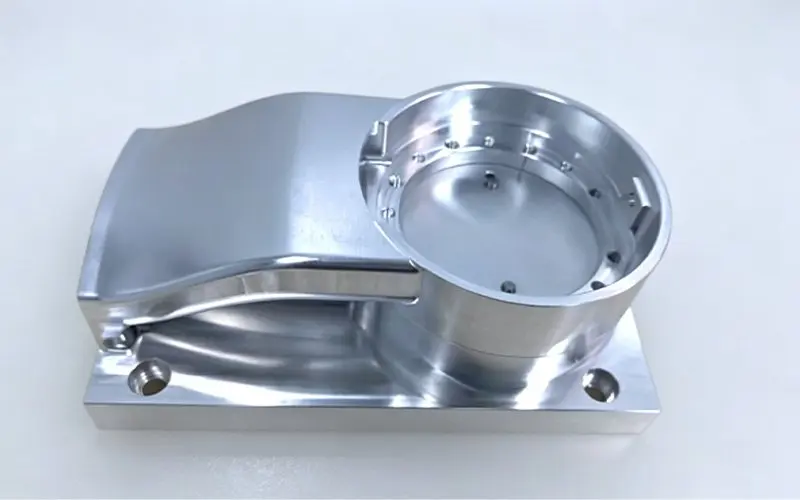
!Alloyer CNC machined aluminum 7075 humanoid robot shoulder joint housing with anodized finish Caption: A 5-axis CNC-machined 7075-T6 aluminum shoulder joint motor housing for a humanoid robot. Alloyer delivers precision components like this with H7 tolerances for bearing bores in 5–7 days.
Key Things to Know About CNC Machining for Humanoid Robots
---
Why Humanoid Robots Demand Specialized CNC Machining
Humanoid robots impose extreme manufacturing constraints. Unlike stationary industrial arms, bipedal systems must manage dynamic loads with minimal self-weight while maintaining sub-millimeter positioning accuracy.
Joint Dynamics and Housing Stiffness
Bipedal locomotion subjects joints (hip, knee, ankle) to complex cyclic loading — tension, compression, and torsion in rapid alternation. A CNC-machined housing from Aluminum 7075-T6 provides the necessary stiffness to prevent deflection under load, which would otherwise corrupt encoder feedback and degrade balance control. For the highest-stress joints (e.g., hip pitch), Ti-6Al-4V offers 60% higher specific stiffness but at 5–8× the machining cost.Space Constraints and Component Integration
Actuators, sensors, and power electronics must fit inside the joint envelope with millimeters to spare. CNC-machined parts enable thin-wall structures (down to 1.2 mm in aluminum) that remain structurally sound, along with pocketing and lightening channels that reduce mass without sacrificing torsional rigidity.Repeatability Across Batches
Humanoid prototypes iterate fast — a 20-DOF humanoid may require 40+ unique machined parts per revision. Alloyer's low-volume CNC workflow supports batch sizes of 1–100 pieces with consistent tolerances, enabling rapid design validation without tooling investment.---
Material Properties for Humanoid Robotics Components
| Material | Density (g/cm³) | Yield Strength (MPa) | Elastic Modulus (GPa) | Machinability | Cost Index* | Typical Humanoid Application |
|---|---|---|---|---|---|---|
| Al 6061-T6 | 2.70 | 276 | 68.9 | Excellent | 1.0x | Structural links, battery enclosures |
| Al 7075-T6 | 2.81 | 503 | 71.7 | Good | 1.5x | Joint housings, actuator brackets |
| Ti-6Al-4V | 4.43 | 880 | 113.8 | Poor | 8.0x | Hip/Ankle pitch joints, high-load pins |
| PEEK | 1.30 | 100 | 3.6 | Fair | 15.0x | Insulated sensor mounts, low-friction slides |
| Nylon 12 (GF) | 1.10 | 48 | 2.5 | Good | 1.2x | Cable management, impact covers |
| 17-4PH Steel | 7.80 | 1170 | 196.5 | Fair | 3.5x | Drive shafts, planetary gears |
---
Technical Deep Dive: Critical Tolerances for Humanoid Actuators
Humanoid robots rely on cycloidal or planetary actuators. The efficiency of these units depends on the concentricity of the machined housings.
1. Bearing Bores: H7 (+0.021/0 mm) is mandatory for press-fit bearings. Anything looser leads to bearing race slip; anything tighter risks premature bearing failure due to excessive preload. 2. Planarity of Face Mounts: Mounts for high-torque motors must be flat within 0.015 mm per 100 mm. Any tilt causes shaft misalignment, increasing gear wear and reducing total system efficiency by up to 15%. 3. True Position: Bolt patterns for high-ratio gearboxes must maintain a true position within 0.05 mm to ensure even load distribution across all gear teeth.
---
DFM Checklist for Humanoid Robot Parts
1. Machinability: Avoid internal sharp corners (90°). Use a minimum radius of 3 mm to allow the use of standard 6 mm end mills, which are more rigid and faster than smaller tools. 2. Wall Thickness: Maintain a minimum of 1.2 mm in aluminum to prevent "chatter" and warping during machining. For PEEK, aim for 2.0 mm to ensure dimensional stability. 3. Tapped Holes: In 7075 aluminum, ensure a thread engagement of at least 2x the bolt diameter (e.g., 6 mm thread for an M3 screw) to prevent stripping under dynamic robot loads. 4. Surface Finish: Specify Ra 0.8 µm for bearing bores and Ra 1.6 µm for general structural surfaces. Specifying Ra 0.4 µm everywhere increases cost by 40% with no functional benefit to flight or walk performance.
---
Cost and Lead Time Reference for Robotics Batches
| Material | Batch Size | Typical Lead Time | Cost Impact |
|---|---|---|---|
| Aluminum (6061/7075) | 1–5 | 72 hours | 1.0x |
| Aluminum (6061/7075) | 50–100 | 7–10 days | 0.6x (per unit) |
| Titanium Gr 5 | 1–5 | 5–7 days | 6.0x |
| PEEK (Engineering Plastic) | 1–5 | 3–5 days | 12.0x |
---
Frequently Asked Questions
What is the best material for a bipedal robot frame?
For most humanoid frames, Aluminum 7075-T6 offers the best trade-off. It is nearly as strong as steel but significantly lighter, allowing for better battery life and more agile movement.How do I handle high-stress joints?
For hip and ankle joints that carry the full weight of the robot during impact, we recommend Titanium Grade 5 (Ti-6Al-4V). It provides the necessary fatigue resistance to handle millions of footfalls without cracking.Can I get an instant quote for my robot parts?
Yes. Upload your CAD files to the Alloyer Instant Quote engine to receive a price and DFM feedback in seconds.---
Related Guides for Robotics Engineers
---