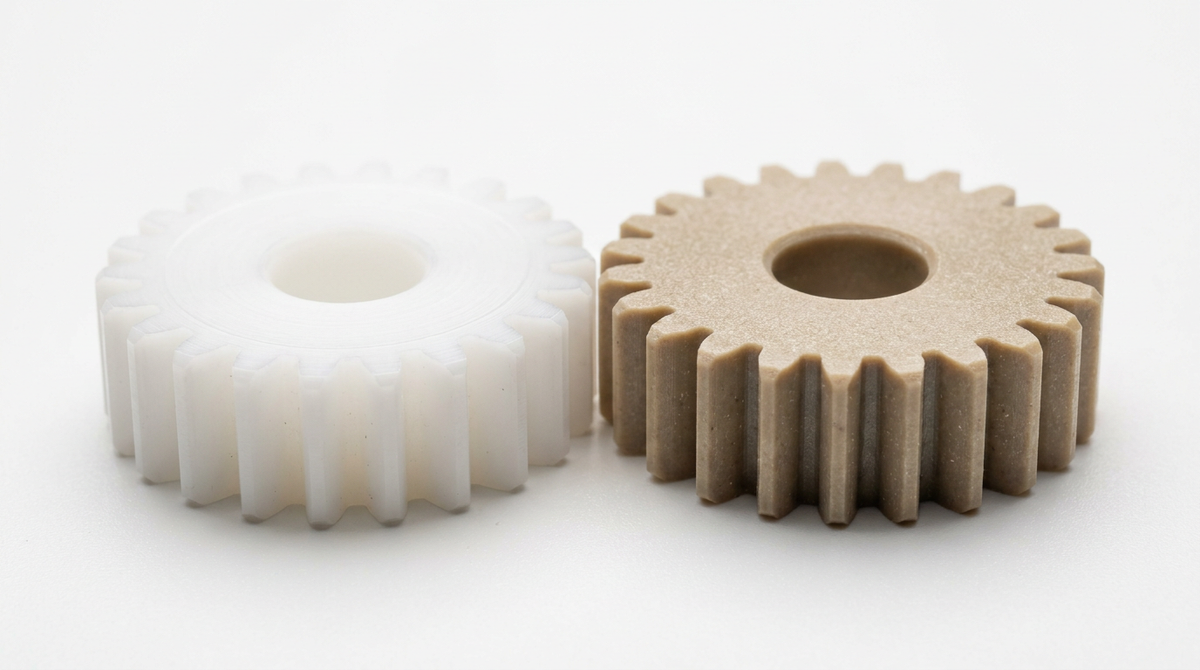

In robotics manufacturing, choosing between PEEK and Delrin (Acetal/POM) often comes down to a trade-off between thermal stability and cost-efficiency. While PEEK is the high-performance choice for high-heat, high-stress humanoid joints, Delrin remains the king of low-friction components like gears and bushings in standard operating environments.
Key Things to Know
---
1. PEEK: The High-Performance Workhorse
PEEK is a semi-crystalline thermoplastic with mechanical properties that rival some metals. In robotics, it is used where weight reduction is required without sacrificing structural integrity.
Properties
Best For
CNC Considerations
PEEK is a "Medium" machinability material (Rating C). Its main challenge is thermal expansion. If heat builds up during milling, the material can expand and then shrink after the tool passes, leading to undersized bores. At Alloyer, we use sharp carbide tools and specialized cooling to maintain ±0.02 mm tolerances.---
2. Delrin (POM): The Precision Specialist
Delrin, or Acetal, is the most common engineering plastic for robotics due to its balance of strength, stiffness, and low friction.
Properties
Best For
CNC Considerations
Delrin has "Excellent" machinability (Rating A). It produces consistent, manageable chips and allows for very high feed rates. However, deburring can be a challenge as the material is tough; high-speed finishing passes are required to ensure smooth edges for robot gear meshes.---
Material Comparison Table
| Property | PEEK | Delrin (POM) | Aluminum 6061-T6 (Ref) |
|---|---|---|---|
| Density (g/cm³) | 1.32 | 1.41 | 2.70 |
| Tensile Strength (MPa) | 97 | 69 | 276 |
| Max Operating Temp (°C) | 250 | 90 | 150 |
| Machinability | Rating C (Fair) | Rating A (Excellent) | Rating A (Excellent) |
| Cost Index | 15.0x | 0.8x | 1.0x |
| Moisture Absorption | 0.1% | 0.2% | 0% |
DFM Tips for Plastic Robot Parts
1. Avoid Sharp Internal Corners Plastics are sensitive to stress concentrations. Ensure all internal pockets have a radius of at least 1.5mm to prevent crack propagation under cyclic robotic loads.
2. Wall Thickness Consistency Maintain a minimum wall thickness of 1.5 mm for Delrin and 1.0 mm for PEEK. Thinner walls are prone to warping due to internal material stresses during machining.
3. Thread Engagement For load-bearing mounts, use helical wire inserts (Heli-Coils) in plastic parts. If threading directly, ensure a thread engagement length of at least 2.5x the bolt diameter.
4. Tolerance Selection Do not over-specify tolerances. While Alloyer can hit ±0.01 mm in plastics, a standard ±0.05 mm is sufficient for 90% of robotic plastic components and significantly reduces manufacturing cost.
---
FAQ
When should I upgrade from Delrin to PEEK?
Upgrade to PEEK if your robot component will exceed 90°C (common near high-torque motors) or if the part requires the absolute maximum tensile strength possible in a polymer.Is Delrin better for gears than PEEK?
Generally, yes. Delrin has a lower coefficient of friction and better dimensional stability over time in standard environments, making it more reliable for precision gear meshes.How does moisture affect these materials?
Both are highly resistant to moisture. However, Delrin can swell slightly (up to 0.2%) in 100% humidity, whereas PEEK remains almost entirely stable (0.1%).Can I get 1-piece prototypes in PEEK?
Yes. At Alloyer, we specialize in 1-piece prototyping for robotics. Given the high cost of PEEK stock, our DFM review ensures your design is optimized to minimize material waste.What is the lead time for CNC machined PEEK parts?
Typically 3-5 business days for prototypes. We maintain a stock of common PEEK and Delrin plate/rod sizes to ensure rapid turnaround.---
More from Alloyer Blog
Ready to machine your robotic components? Upload your CAD for an instant DFM review and material recommendation. 1-piece prototyping accepted. Get Quote →