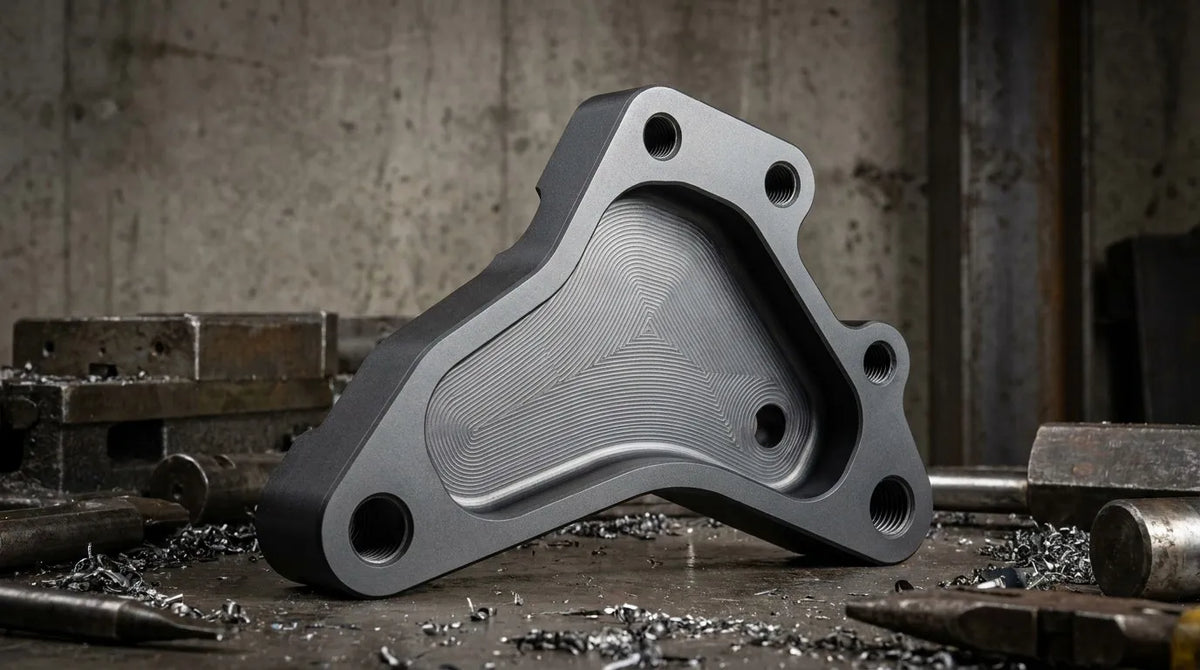
CNC machining for construction robots is the heavy-duty manufacturing process of producing impact-resistant structural frames, high-torque actuator housings, and wear-proof end-effectors for autonomous bricklaying, excavation, and demolition systems. Construction robotics demands extreme structural durability, resistance to concrete dust and abrasive slurry, and absolute mechanical reliability under multi-ton payloads. Alloyer specializes in precision 5-axis CNC machining for heavy industrial automation with 72-hour delivery, zero minimum order quantity, and automated DFM reviews.
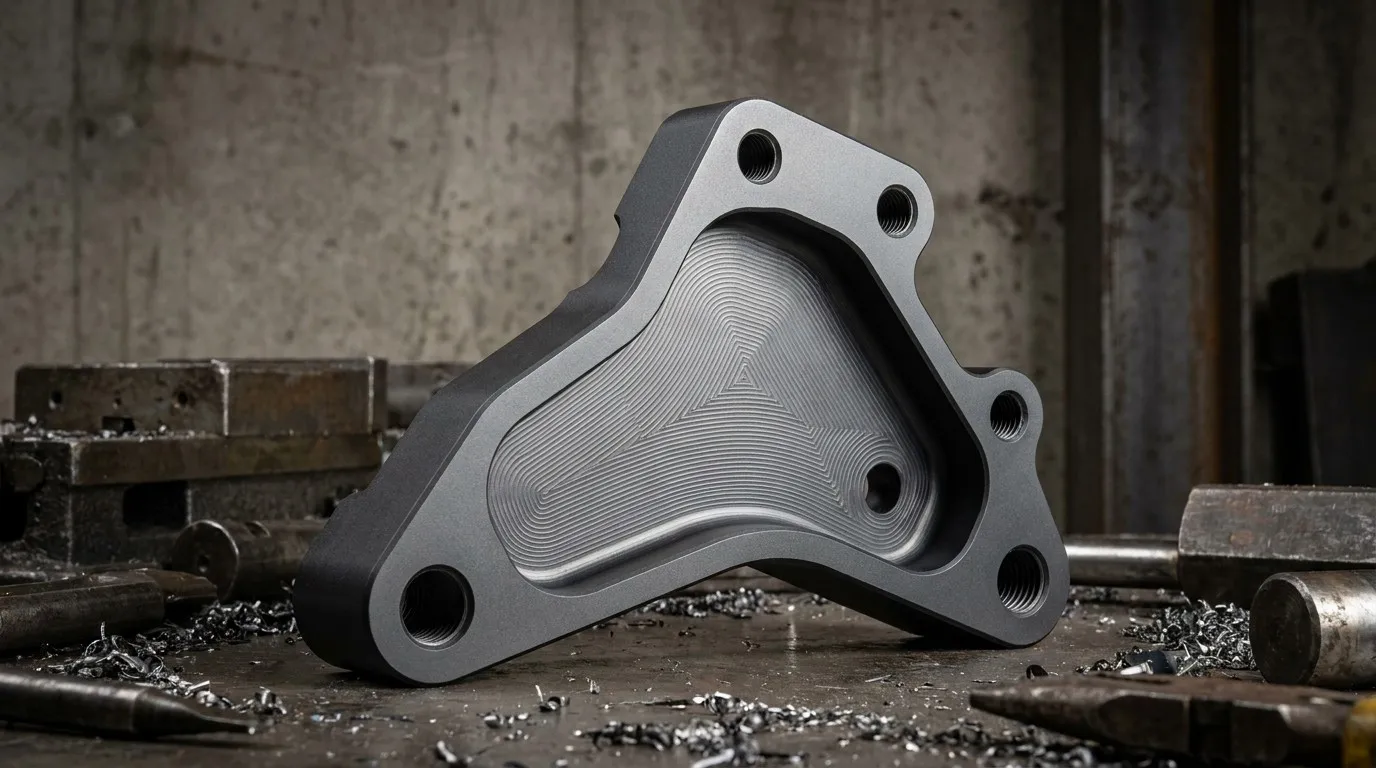 Caption: A high-precision CNC-machined 7075-T6 aluminum structural bracket for a heavy-duty construction robot. Alloyer maintains strict H7 tolerances for bearing journals and reinforced bolt patterns to survive continuous multi-ton payloads in concrete-dust environments.
Key Things to Know About CNC Machining for Construction Robots
- 7075-T6 for Structural Rigidity: The arms and frames of bricklaying and excavation robots must survive massive impulsive loads. Aluminum 7075-T6 provides the yield strength (503 MPa) to handle 1,000+ kg payloads while keeping the manipulator light enough for precise control.
- Wear-Proof Surfaces: Concrete slurry and silica dust are highly abrasive. CNC-machined parts in SS 17-4PH (hardened to HRC 44) and Hardox 450 wear plates are specified for joints and scrapers that directly contact rough materials.
- Shock-Loaded Bearing Fits: Pivot points experiencing hammer-like vibration require H7 (+0.021/0 mm) tolerances on bores. Any play in the joint amplified through a 3-meter arm causes micro-cracking in welds and mechanical failure.
- Dust-Proof Sealing (IP67): Cement dust penetrates standard seals. CNC-machined O-ring glands with Ra 0.8 μm mirror finishes and double-lip seal geometries are essential for protecting internal gearboxes.
- DFM for Fleet Durability: Construction robot fleets operate across multiple sites. Incorporating Helicoil inserts and modular interchangeable link interfaces ensures a robot can be repaired on a construction site without specialized CNC equipment.
Why Construction Robots Demand Specialized CNC Machining
Construction sites are extreme mechanical environments. Robots are expected to lay bricks within 1 mm of precision, drill through reinforced concrete, or demolish steel structures—all while being battered by dust, vibration, and wide temperature swings.
High-Cycle Impact Fatigue
A demolition robot breaker hammer can deliver up to 1,500 blows per minute to a concrete slab. The structural arm must absorb this energy without developing stress fractures. CNC machining from solid 7075-T6 aluminum or SS 17-4PH stainless steel billets ensures an isotropic, void-free internal structure that can survive millions of impact cycles without crack propagation.
Particulate Ingress and Sealing
The primary killer of construction actuators is dust. Unlike molded or cast parts, CNC-machined housings feature perfectly flat sealing surfaces with Ra 0.8 μm finishes. This provides a rigid foundation for double-lipped seals and wipers, protecting the high-ratio harmonic and cycloidal gearboxes from abrasive slurry penetration.
Robotic Masonry and 1 mm Accuracy
Autonomous bricklaying robots must place bricks with sub-millimeter accuracy over a 10-meter work envelope. CNC machining provides the structural "backbone" for this accuracy. By holding H7 (+0.015/0 mm) bearing tolerances and ensuring the absolute parallelism of mounting faces (within 0.02 mm), we eliminate the mechanical deflection that causes cumulative placing errors in a long-reach manipulator.
Material Properties for Construction Robotics Components
| Material | Density (g/cm³) | Yield Strength (MPa) | Wear Resistance | Machinability | Cost Index* | Construction Application |
|---|---|---|---|---|---|---|
| Al 7075-T6 | 2.81 | 503 | Good (Hardcoat) | Good | 1.5x | Arm links, chassis frames |
| SS 17-4PH (H900) | 7.80 | 1170 | Outstanding | Fair | 2.5x | Pivot pins, gear shafts |
| Hardox 450 | 7.85 | 1200 | Extreme | Poor | 3.0x | Wear plates, breaker faces |
| POM (Delrin) | 1.41 | 65 | Excellent | Excellent | 0.8x | Dust-seal spacers, slider blocks |
| Al 5083-H116 | 2.66 | 228 | Good | Fair | 1.1x | Corrosion-resistant covers |
Critical Components: CNC Requirements
1. Manipulator Arm Structural Links
Function: Primary load-bearing elements that support multi-ton concrete forms and bricklaying heads. Material: Al 7075-T6 (Type III Hardcoat). Tolerance: H7 (+0.021/0 mm) for pivot bores; ±0.05 mm for link length to ensure kinematic calibration across multi-segment arms. Surface Finish: Ra 3.2 μm + Hardcoat. CNC Challenges: Long links (2+ meters) with aggressive weight-reduction pocketing. Alloyer utilizes custom hydraulic dampening fixtures to prevent "chatter" and ensure straightness over the entire span.2. High-Torque Actuator Housings
Function: House the brushless motors and harmonic drives that control the robot's motion. Material: Al 7075-T6. Tolerance: Concentricity of motor and output bore within ±0.01 mm. Surface Finish: Ra 0.8 μm for sealing interfaces. CNC Challenges: Machining deep bearing pockets with a 3:1 depth-to-diameter ratio. We address tool deflection with precision boring bars and continuous in-process measurement.3. Wear-Proof End-Effectors
Function: Directly contact abrasive materials such as brick surfaces, concrete, or steel scrap. Material: SS 17-4PH or Hardox 450. Tolerance: ±0.05 mm on gripping surfaces. Surface Finish: Ra 0.4 μm on sliding interfaces. CNC Challenges: Machining hardened wear-plate materials (HRC 55+) requires specialized carbide tooling and rigid setups to maintain dimensional accuracy and prevent tool breakage.Tolerances & Surface Finishes for Heavy-Duty Robotics
| Feature | Tolerance | Surface Finish | Notes |
|---|---|---|---|
| Pivot Bore | H7 (+0.021/0 mm) | Ra 0.8 μm | Zero-backlash needed for hammering |
| Pivot Shaft | g6 (-0.004/-0.012 mm) | Ra 0.4 μm | Mirror finish to resist impact pitting |
| Seal Gland (IP67) | +0.05/0 mm | Ra 0.8 μm | Double-lip geometry for dust ingress |
| Wear Plate | ±0.1 mm | Ra 0.8 μm | Replaceable inserts for field service |
DFM Tips for Construction Robot Parts
1. Design for Multi-Site Assembly
Construction robots are disassembled and moved frequently. Use 6 mm dowel pins with H7 tolerances for alignment, and incorporate M10-M12 Helicoil inserts in 7075 aluminum to prevent thread stripping during frequent field reassembly.
2. Protect Against Ingress with Lip Seals
Standard O-rings are insufficient in concrete dust. CNC-machined housings should feature stepped "labyrinth" seal grooves with an Ra 0.8 μm finish. Design the dust-side groove to accept a polyurethane wiper seal for maximum grit exclusion.
3. Minimum Internal Radii for Impact
Impact loads concentrate at sharp corners. Design all weight-reduction pockets with a minimum radius of 4 mm (R4) to diffuse stress concentrations. This allows the element to survive millions of hammering cycles without crack initiation.
4. Monolithic Frame Consolidation
Using 5-axis CNC machining, we can replace welded steel frames consisting of 20+ individual brackets with a single closed-box cellular structure. This eliminates weld cracking risks, reduces weight by 35%, and holds H7 tolerances for all pivot joints in one rigid integrated structure.
Cost & Lead Time Reference
| Material | Typical Lead Time | Relative Cost | Min Qty | Recommended Batch |
|---|---|---|---|---|
| Al 7075-T6 | 5-7 days | 1.5x | 1 pc | |
| SS 17-4PH | 5-7 days | 2.5x | 1 pc | |
| POM (Delrin) | 3-5 days | 0.8x | 1 pc | |
| Hardox 450 | 7-10 days | 3.0x | 1 pc |
Frequently Asked Questions
Q: What is the best material for a construction robot arm?
We recommend Aluminum 7075-T6 for its combination of fatigue life (503 MPa yield strength) and light weight. This enables high payload capacity (1000+ kg) while ensuring the actuator can control the arm precisely. A Type III Hardcoat Anodize provides the surface durability needed for abrasive construction environments.
Q: How do you protect gearboxes from concrete dust?
Alloyer machines actuator housings with stepped labyrinth seal grooves (Ra 0.8 μm) and polyurethane wiper interfaces. This dual-stage protection ensures that the fine silica dust generated by cutting and drilling does not reach the harmonic drive gears, extending field life by 3x.
Q: Can Alloyer machine structural frames that replace welded assemblies?
Yes. Our 5-axis CNC centers produce monolithic cellular frames that replace 20+ piece welded steel assemblies. This reduces weight by 35%, eliminates weld failure risks, and holds H7 tolerances for all joint pivots in a single setup.
Q: Why is 1-piece CNC prototyping critical for construction robotics?
A structural failure in a 3-meter arm lifting 2 tons is catastrophic. 1-piece CNC allows you to test the actual fatigue performance of a 7075 aluminum link in just 72 hours, validating your FEA models under real site conditions before deploying a full fleet.
More from Alloyer Blog
Need heavy-duty construction robot parts fast?
Upload your CAD files to Alloyer's automated engine for an instant price quote and a free DFM check. Standard AL 6061 parts start from $8.99, and we accept 1-piece prototyping orders.
Upload CAD & Get Quote →