
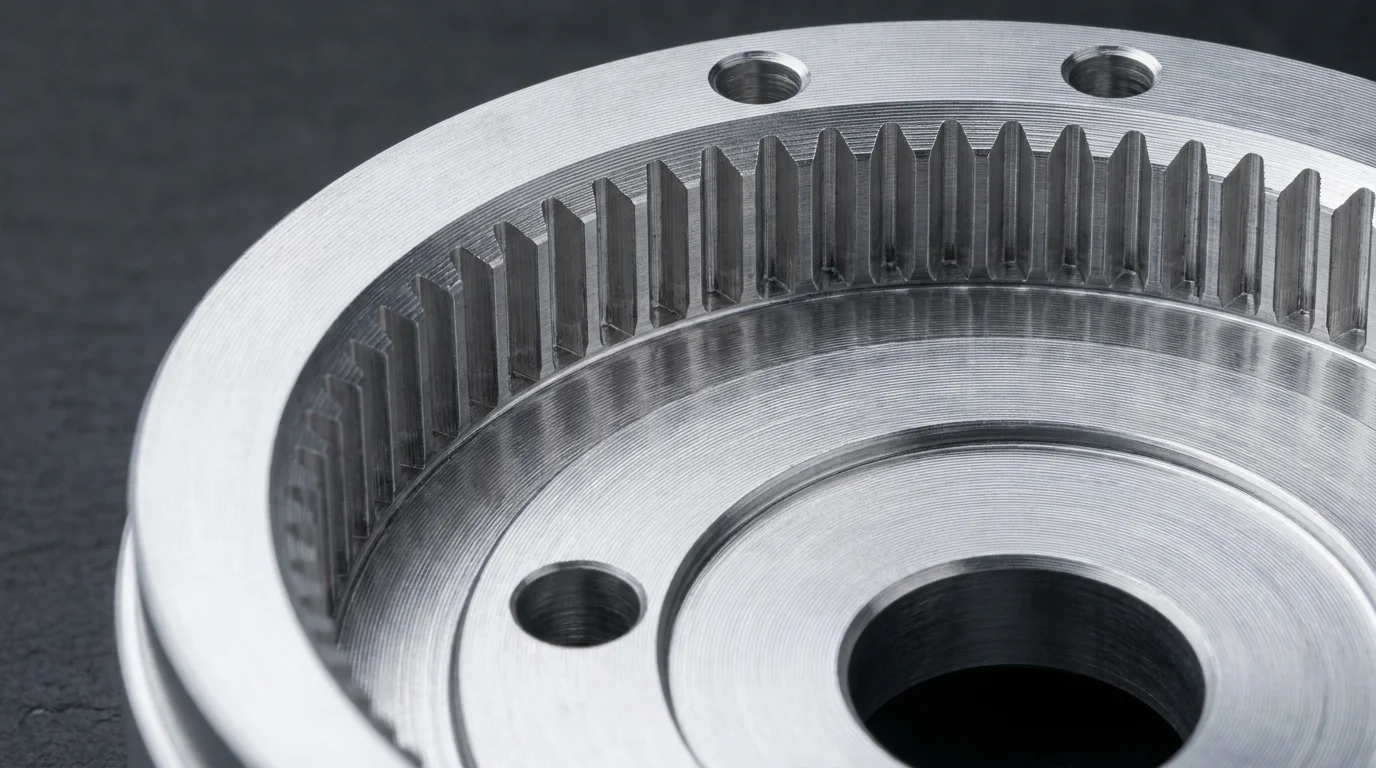
CNC machining for harmonic drive housings is the ultra-precision manufacturing process used to produce rigid circular splines, flexible gear cups (flexsplines), and wave generator plugs. These housings require sub-micron concentricity, H7 bearing bore tolerances, and specialized cutting strategies to ensure zero-backlash torque transmission. Alloyer specializes in high-precision CNC machining for robotic joint actuators with 72-hour delivery, integrated DFM reviews, and a 1-piece minimum order quantity.
Key Things to Know About CNC Machining for Harmonic Drive Housings
- Material Selection: Aluminum 7075-T6 is the rigid standard for outer housings to minimize weight, while 17-4PH stainless steel is specified for flexsplines to handle millions of elastic deformation cycles.
- Dimensional Accuracy: Bearing journals and concentric bores must hold H7 (+0.015/0 mm) tolerances to prevent radial runout, which degrades gear tooth engagement.
- Flexspline Thin-Wall Challenge: Machining the flexible cup of a harmonic drive requires turning wall thicknesses below 0.5 mm. High-feed milling and dampening fixtures are required to prevent vibration and deflection.
- Surface Finishes: Internal spline interfaces require Ra 0.8 μm finishes followed by Type III hardcoat anodizing to resist friction-induced abrasive wear.
- Design for Manufacturability (DFM): Keeping internal tooth depth-to-width ratios below 3:1 allows wire EDM or high-speed gear shaping to cut teeth without tool deflection, saving up to 45% in manufacturing costs.
Why Harmonic Drive Housings Require Specialized CNC Machining
Harmonic drives (also known as strain wave gears) are the gold standard for high-ratio, zero-backlash speed reduction in humanoid robotic joints and robotic arms. However, the unique mechanics of the strain wave transmission introduce extreme demands on the CNC machining of their housings.
High-Frequency Elastic Deformation and Fatigue Resistance
The wave generator stretches the thin-walled flexible spline (flexspline) into an elliptical shape, forcing its outer teeth to mesh with the inner teeth of the rigid circular spline. As the wave generator rotates, the flexspline undergoes continuous elastic deformation. Specifying materials like SS 17-4PH (precipitation hardened to H900) or high-grade Ti-6Al-4V is essential. These metals offer the fatigue limit required to survive millions of cycles of localized strain without cracking.
Absolute Concentricity and Angular Alignment
Any misalignment between the circular spline housing and the wave generator input shaft causes unequal load distribution on the gear teeth. A concentricity error of just 0.010 mm can increase gear wear by 200% and introduce a "cogging" torque that ruins the smooth locomotion of humanoid legs or manipulator arms. Machining the critical bearing journals and internal splines in a single multi-axis setup is the only way to eliminate tolerance stack-up.
Lightweight Optimization for Embodied AI
Robots that walk or fly must keep their joints as light as possible. Every gram saved on a joint housing reduces the torque required from the actuator motors. CNC-machined 7075-T6 aluminum housings offer a yield strength of 503 MPa, comparable to structural steel, but at one-third the density. This high strength-to-weight ratio allows designers to engineer paper-thin outer shells with internal ribbing that maintains high torsional rigidity.
Material Properties for Harmonic Drive Components
| Material | Density (g/cm³) | Yield Strength (MPa) | Elastic Modulus (GPa) | Machinability | Cost Index | Robotic Application |
|---|---|---|---|---|---|---|
| Al 6061-T6 | 2.70 | 276 | 68.9 | Excellent | 1.0x | Outer covers, dust shields, spacer rings |
| Al 7075-T6 | 2.81 | 503 | 71.7 | Good | 1.5x | Rigid circular spline housings, mounting brackets |
| SS 17-4PH | 7.80 | 1000 | 204 | Fair | 2.5x | Thin-walled flexible spline (flexspline) cups |
| Ti-6Al-4V | 4.43 | 880 | 113.8 | Poor | 8.0x | Ultra-lightweight aerospace-grade flexsplines |
| PEEK | 1.30 | 100 | 3.6 | Medium | 15.0x | Insulating motor spacers, low-friction seal guides |
| POM (Delrin) | 1.41 | 65 | 2.9 | Excellent | 0.8x | High-efficiency internal dust seals, wiring covers |
| Nylon PA6 | 1.14 | 60 | 2.5 | Good | 0.6x | External cable guides, non-structural covers |
| FR4/G10 | 1.85 | 340 | 24 | Fair | 1.2x | Electrical isolator rings, internal sensor mounts |
Cost Index relative to Al 6061-T6 per kg including typical CNC cycle cost. ASTM/ISO standard values.
Critical Components: CNC Requirements
1. The Flexspline (Flexible Spline Cup)
Function: The flexible cup that deforms elastically to transmit torque to the joint output.
Material: Stainless Steel 17-4PH or Titanium Grade 5.
Tolerance: Concentricity of outer spline teeth to inner bearing journal within ±0.008 mm.
Surface Finish: Ra 0.4 μm on the internal bearing bore; Ra 0.8 μm on outer gear teeth.
CNC Challenges: Wall thicknesses of 0.4 mm are highly prone to warping under the heat and pressure of turning tools. Alloyer addresses this by using custom internal expansion mandrels and continuous oil coolant to stabilize the workpiece, ensuring a perfect elliptical shape without deflection.
2. The Circular Spline (Rigid External Housing)
Function: The rigid ring with internal teeth that remains fixed to the robot’s link structure.
Material: Aluminum 7075-T6.
Tolerance: H7 (+0.015/0 mm) for the alignment register; radial runout within 0.005 mm.
Surface Finish: Ra 0.8 μm for the mating flange.
CNC Challenges: Specifying internal teeth requires either gear shaping, wire EDM, or custom broaching. For prototyping, wire EDM is the most cost-effective method to achieve sharp internal corner geometries (radius < 0.1 mm) in hardened 7075-T6 aluminum.
3. The Wave Generator Plug
Function: The elliptical steel core that stretches the flexspline into its mesh shape.
Material: SS 17-4PH (H900) or hardened tool steel.
Tolerance: Elliptical profile contour accuracy within ±0.005 mm.
Surface Finish: Ra 0.2 μm on the outer contact surface.
CNC Challenges: Turning a non-circular elliptical profile requires CNC lathes with specialized active C-axis oscillation or specialized cylindrical grinding. Alloyer utilizes state-of-the-art multi-axis grinding centers to achieve sub-micron profile accuracy.
Tolerances & Surface Finishes for Harmonic Drives
| Component Feature | Standard Tolerance | Required Surface Finish | Manufacturing Notes |
|---|---|---|---|
| Flexspline Bearing Journal | H6 (+0.009/0 mm) | Ra 0.4 μm | Requires post-heat-treat cylindrical grinding |
| Circular Spline Mating Bore | H7 (+0.015/0 mm) | Ra 0.8 μm | Must be concentric with internal gear teeth |
| Housing Mounting Flange | ±0.02 mm | Ra 1.6 μm | Flatness within 0.01 mm is critical to prevent leaks |
| Wave Generator Shaft Fit | g6 (-0.004/-0.015 mm) | Ra 0.8 μm | Interference fit requiring hydraulic assembly |
| Elliptical Outer Race | Profile ±0.005 mm | Ra 0.2 μm | Precision ground to reduce friction against bearings |
DFM Tips for Harmonic Drive Housings
- Avoid Sharp Spline Tooth Roots: Designing square tooth bases forces the use of micro-tools that break easily and slow down cycle times. Instead, specify a minimum radius of 0.2 mm at the root of the internal teeth to allow for wire EDM or precision gear shaping.
- Optimize Bore Depth-to-Diameter Ratios: Keep deep bearing bores below a 3:1 depth-to-diameter ratio. Deeper bores cause tool deflection and chatter, which compromises the tight H7 tolerances needed for the wave generator bearings.
- Specify Aluminum 7075 for Static Enclosures: While steel or titanium is necessary for the moving, high-load gears, the non-meshing outer covers should be made of Aluminum 6061-T6 or 7075-T6. This simple material swap reduces outer enclosure costs by up to 60% and cuts weight by more than half.
- Incorporate Flange Alignment Dowels: Add two precision reamed dowel holes (H7 tolerance) to the mounting flange. This makes it easy for assembly teams to align the motor shaft perfectly with the harmonic drive core, avoiding radial stress.
Cost & Lead Time Reference
| Material | Typical Lead Time | Relative Cost | Minimum Quantity |
|---|---|---|---|
| Al 6061-T6 | 3-5 days | 1.0x | 1 pc |
| Al 7075-T6 | 5-7 days | 1.5x | 1 pc |
| SS 17-4PH | 5-7 days | 2.5x | 1 pc |
| Ti-6Al-4V | 7-10 days | 8.0x | 1 pc |
| PEEK | 5-7 days | 15.0x | 1 pc |
| POM (Delrin) | 3-5 days | 0.8x | 1 pc |
Frequently Asked Questions
Q: What is the optimal material combination for a high-torque robotic harmonic drive assembly?
We recommend Aluminum 7075-T6 for the outer circular spline housing to minimize joint weight, and Stainless Steel 17-4PH (H900 hardened) for the flexspline cup to handle fatigue from the elliptical wave generator. Standard AL 6061 is ideal for static outer covers to save cost.
Q: How do you prevent thin-wall warping when machining the flexspline cup?
Walls below 0.5 mm in steel tend to vibrate and deflect during turning. Alloyer solves this using custom-machined internal expansion mandrels that support the thin cup wall, combined with sharp carbide tooling and micro-step feeds, holding circularity within 0.008 mm.
Q: What is the maximum tolerance stack-up allowed for harmonic drive alignment?
The alignment of the circular spline register must be held within H7 (+0.015/0 mm) and runout within 0.005 mm. Any misalignment greater than 0.02 mm causes severe tooth interference, causing backlash, reduced gear efficiency, and rapid component failure.
Q: Can Alloyer machine the specialized elliptical profile of the wave generator?
Yes. We machine wave generator plugs using multi-axis CNC grinding centers with active C-axis compensation. We achieve profile contour accuracies within ±0.005 mm and mirror-like surface finishes of Ra 0.2 μm to minimize friction.
More from Alloyer Blog
- CNC Machining for Robotic Actuator Housings: Materials, Tolerances & DFM Guide
- CNC Machining for Humanoid End-Effectors: Design, Materials & DFM Guide
- CNC Machining for High-Precision Robotic Gearboxes: Materials & DFM Guide
Need precision harmonic drive housings or robotic joint components fast?
Upload your CAD files to Alloyer’s automated engine for an instant price quote and a free DFM check. Standard AL 6061 parts start from $8.99, and we accept 1-piece prototyping orders.
Upload CAD & Get Quote →