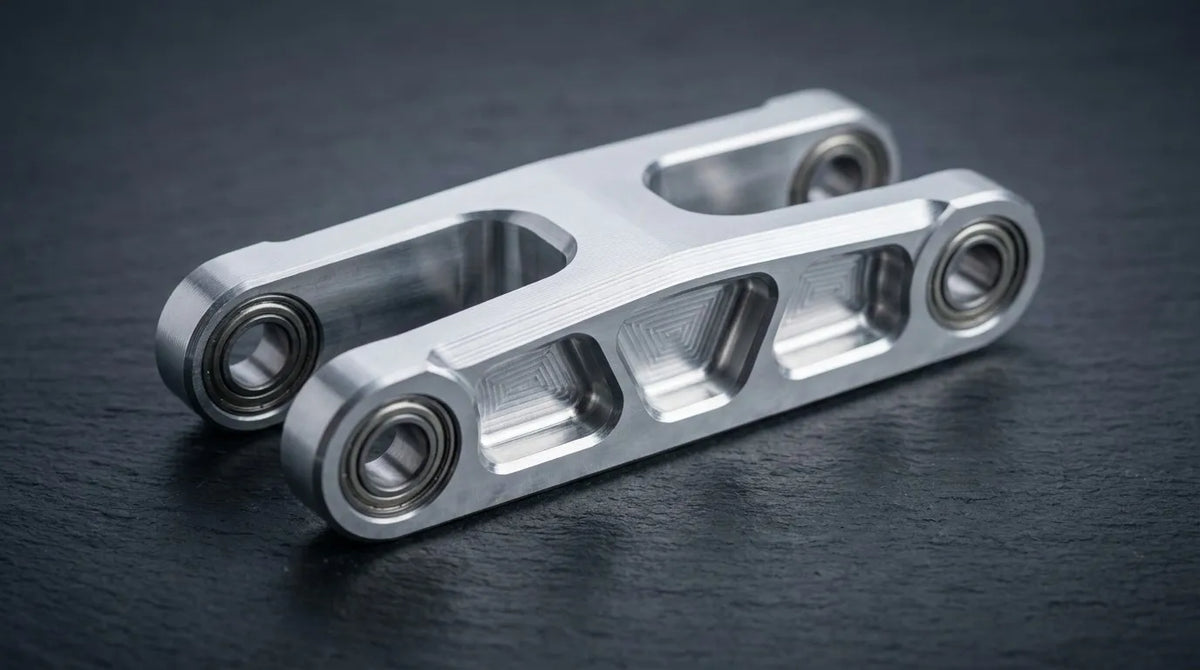
CNC machining for warehouse automation robots is the high-speed manufacturing process of producing durable structural frames, high-cycle gripper assemblies, and precision drive-train housings for autonomous mobile robots (AMRs), automated guided vehicles (AGVs), and high-throughput sorting systems. Logistics robotics demands high-wear durability, absolute positional repeatability for pallet and tote handling, and lightweight structural optimization for extended battery life. Alloyer specializes in precision 5-axis CNC machining for logistics automation with 72-hour delivery, zero minimum order quantity, and integrated DFM reviews.
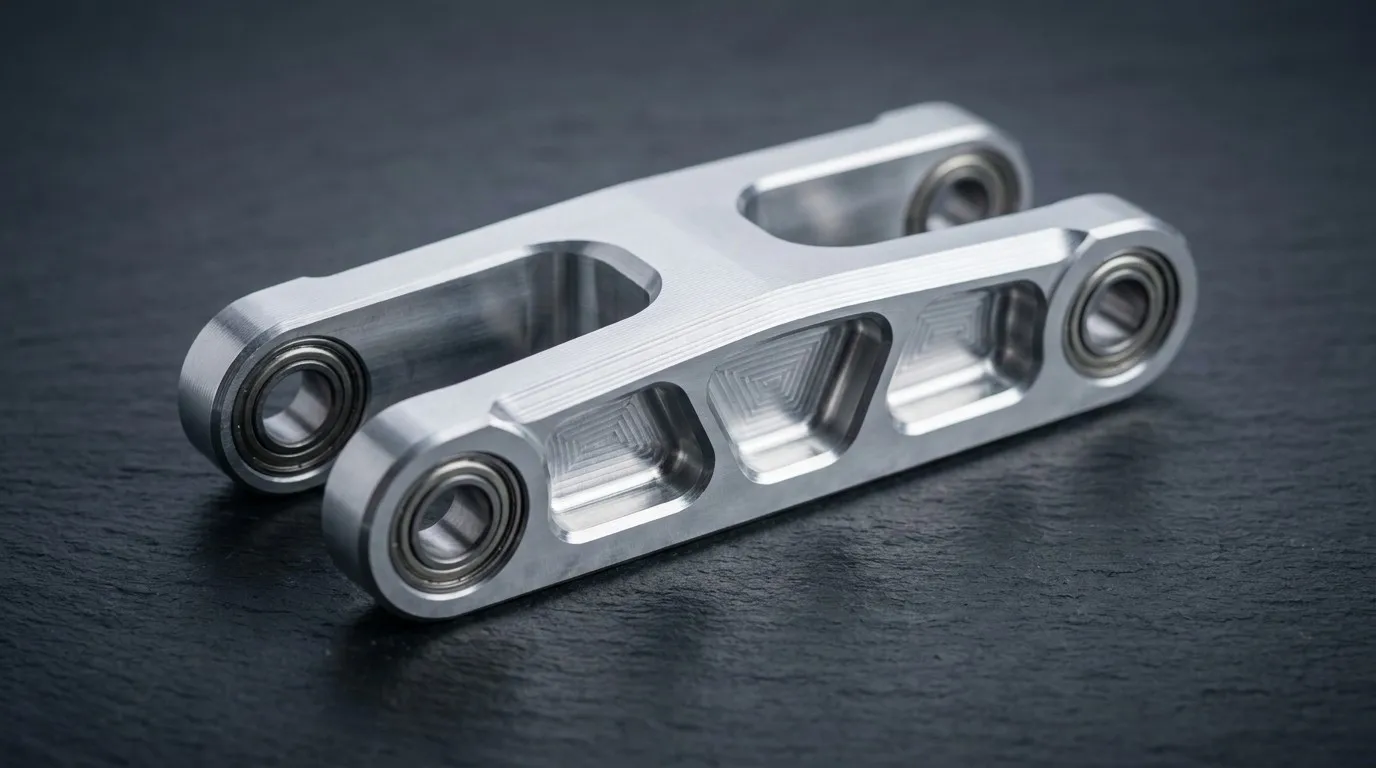 Caption: A high-precision CNC-machined 7075-T6 aluminum structural link for a warehouse AMR. Alloyer maintains strict H7 tolerances for drive-train bearing bores and Ra 0.8 μm surface finishes for high-wear sliding interfaces, ensuring millions of maintenance-free cycles in 24/7 fulfillment center operations.
Key Things to Know About CNC Machining for Warehouse Robots
- 7075-T6 for Structural Frames: The chassis of high-speed AMRs must survive constant vibration and impact. Aluminum 7075-T6 provides the yield strength of structural steel at one-third the weight, maximizing payload capacity.
- High-Wear Durale Survivability: Fulfillment center robots operate 24/7. Actuator gears and sliding gripper faces require materials like 17-4PH Stainless Steel and engineered plastics such as POM (Delrin) to survive millions of cycles.
- Positional Accuracy: Robotic arms moving heavy totes require H7 (+0.021/0 mm) tolerance on pivot bores to ensure zero-backlash positioning, preventing mis-picks in dense automated storage systems.
- Weight-Optimized Lightweighting: Every gram saved on the chassis extends battery runtime. Aggressive CNC pocketing removing up to 60% of billet mass is standard for logistics AMR links.
- DFM for High-Volume Scaling: As warehouses scale from 10 to 1,000 robots, components must be designed for repeatable CNC production. Incorporating Helicoils and modular mounting interfaces reduces assembly time by 30%.
Why Warehouse Automation Robots Demand Specialized CNC Machining
The modern fulfillment center operates at a relentless pace. Robots shuttle between high-density racks, transporting payloads of 300 kg or more across millions of square feet. The mechanical demands are immense.
Continuous Duty Cycle and Fatigue Life
Unlike a research humanoid that runs for 20 minutes, a warehouse AMR runs 22 hours a day. The structural links and actuator housings are subjected to billions of micro-stress cycles. CNC machining from solid billets—rather than casting or 3D printing—provides the dense, isotropic metal structure required to survive this lifespan without crack propagation or fatigue failure.
High-Speed Dynamic Loading
A sorting robot arm may complete a pick-and-place cycle in under 500 milliseconds. This generates massive impulse loads at the pivot points. Material selection is critical: we utilize case-hardened 17-4PH Stainless Steel for pivot pins and actuator shafts, while the lightweight structural links are machined from 7075-T6 Aluminum for optimal inertial damping.
Modular Scalability
Modern warehouses use a modular fleet of AMRs (Autonomous Mobile Robots). Each robot's chassis must be lightweight but strong enough to carry standardized module payloads. CNC machining allows for the integration of mounting interfaces (5 mm dowel pins, M8-M10 threaded inserts) directly into the structure, enabling fleets to be reconfigured and maintained without specialized tooling.
Material Properties for Warehouse Robotics Components
| Material | Density (g/cm³) | Yield Strength (MPa) | Wear Resistance | Machinability | Cost Index* | Warehouse Application |
|---|---|---|---|---|---|---|
| Al 6061-T6 | 2.70 | 276 | Moderate | Excellent | 1.0x | Tote shelves, sensor brackets |
| Al 7075-T6 | 2.81 | 503 | Good | Good | 1.5x | AMR chassis, lifting arms |
| SS 17-4PH | 7.80 | 1000 | Outstanding | Fair | 2.5x | Pivot pins, gear shafts |
| POM (Delrin) | 1.41 | 65 | Excellent | Excellent | 0.8x | Slider blocks, gripper pads |
| PEEK | 1.30 | 100 | Excellent | Medium | 15.0x | High-cycle bearing cages |
Critical Components: CNC Requirements
1. AMR Chassis Structural Links
Function: The primary skeleton that supports the drive train, battery pack, and payload. Material: Al 7075-T6 (Type III Hardcoat). Tolerance: ±0.03 mm on mounting hole patterns to ensure fleet interchangeability. Surface Finish: Ra 1.6 μm + Hardcoat anodize. CNC Challenges: Aggressive pocketing ("lightweighting") to minimize mass while maintaining >100,000 cycle fatigue life. Alloyer uses 5-axis machining to cut deep pockets and mounting interfaces in a single setup.2. High-Cycle Gripper Assemblies
Function: Physically grasp and manipulate totes, boxes, and pallets at high speed. Material: Al 7075-T6 for the frame, POM (Delrin) for sliding contact faces. Tolerance: H7 (+0.015/0 mm) for pivot bores; 0.02 mm parallelism for gripper fingers. Surface Finish: Ra 0.8 μm on sliding interfaces. CNC Challenges: Maintaining thin wall sections (1.5 mm) in gripper fingers while ensuring dimensional stability for consistent gripping force.3. Drive-Train Motor Housings
Function: Enclose and align the brushless motors and planetary reducers. Material: Al 6061-T6 or Al 7075-T6. Tolerance: H7 (+0.021/0 mm) for bearing seats. Surface Finish: Ra 0.8 μm for external heat-sink surfaces. CNC Challenges: Achieving absolute concentricity across multiple bearing bores to prevent hot-spotting and premature motor failure in continuous-duty applications.Tolerances & Surface Finishes for Warehouse Robots
| Feature | Tolerance | Surface Finish | Notes |
|---|---|---|---|
| Bearing Bore (Drive) | H7 (+0.015/0 mm) | Ra 0.8 μm | Eliminates vibration in 24/7 motors |
| Pivot Shaft Fit | g6 (-0.004/-0.012 mm) | Ra 0.4 μm | Required for no-play gripper precision |
| Gripper Sliding Face | ±0.05 mm | Ra 0.8 μm | Self-lubricating delrin inserts preferred |
| Mounting Pattern | ±0.03 mm | Ra 3.2 μm | Critical for modular fleet setups |
DFM Tips for Warehouse Robot Parts
1. Optimize Internal Radii for Lightweighting
Structural links have deep internal pockets to save weight. Design internal corners with a minimum radius of 3 mm (R3) to allow for the use of rigid 6 mm end mills, reducing machining time by 25% and enhancing tool life.
2. Specify a Minimum Wall Thickness of 1.2 mm
For 7075-T6 structural links carrying heavy loads, maintain a wall thickness of at least 1.2 mm. Thinner walls risk buckling during the dynamic acceleration and deceleration cycles of high-speed AMRs (up to 3 m/s).
3. Use Threaded Inserts (Helicoils) in 7075-T6
Warehouse robots are disassembled for periodic maintenance. Directly tapping threads into 7075 aluminum can lead to premature wear. By incorporating Stainless Steel Helicoils, the structural integrity of the link is maintained through hundreds of service cycles.
4. Consolidate Individual Brackets into a Single 5-Axis Part
Traditional box-AMRs often feature dozens of L-brackets. Our 5-axis CNC centers can merge these into a single integrated chassis rail. This eliminates assembly tolerances, reduces weight from fasteners, and increases the overall stiffness of the robot.
Cost & Lead Time Reference
| Material | Typical Lead Time | Relative Cost | Min Qty | Recommended Batch |
|---|---|---|---|---|
| Al 6061-T6 | 3-5 days | 1.0x | 1 pc | |
| Al 7075-T6 | 5-7 days | 1.5x | 1 pc | |
| SS 17-4PH | 5-7 days | 2.5x | 1 pc | |
| POM (Delrin) | 3-5 days | 0.8x | 1 pc | |
| PEEK | 5-7 days | 15.0x | 1 pc |
Frequently Asked Questions
Q: What is the best material for a high-speed AMR structural link?
For most warehouse AMRs, Aluminum 7075-T6 is the optimal choice. With a yield strength (503 MPa) comparable to structural steel but at one-third the mass, it provides the inertial damping and fatigue life needed for 24/7 high-speed shuttle operations. A Type III Hardcoat Anodize provides the surface durability for fleet deployments.
Q: How do you prevent wear in high-cycle gripper joints?
Alloyer incorporates POM (Delrin) sliding inserts and precision g6 pivot pins to eliminate metal-on-metal contact in gripper assemblies. The parts are CNC-machined to Ra 0.8 μm finishes, and self-lubricating plastics ensure maintenance-free operation over millions of pick-and-place cycles.
Q: Can Alloyer machine structural AMR chassis parts in a single setup?
Yes. Our 5-axis CNC centers can produce complex monolithic structural rails, eliminating the need for multiple bolt-on brackets. This improves assembly accuracy and reduces the overall mass of the robot while holding H7 bearing tolerances.
Q: How does CNC prototyping benefit warehouse automation startups?
1-piece CNC prototyping allows logistics startups to test a full-scale AMR chassis link in the real-world material (7075 Aluminum) in just 72 hours. This validates the structural integrity under dynamic payload testing before committing to large-scale production.
More from Alloyer Blog
Need precision warehouse robot components fast?
Upload your CAD files to Alloyer’s automated engine for an instant price quote and a free DFM check. Standard AL 6061 parts start from $8.99, and we accept 1-piece prototyping orders.
Upload CAD & Get Quote →