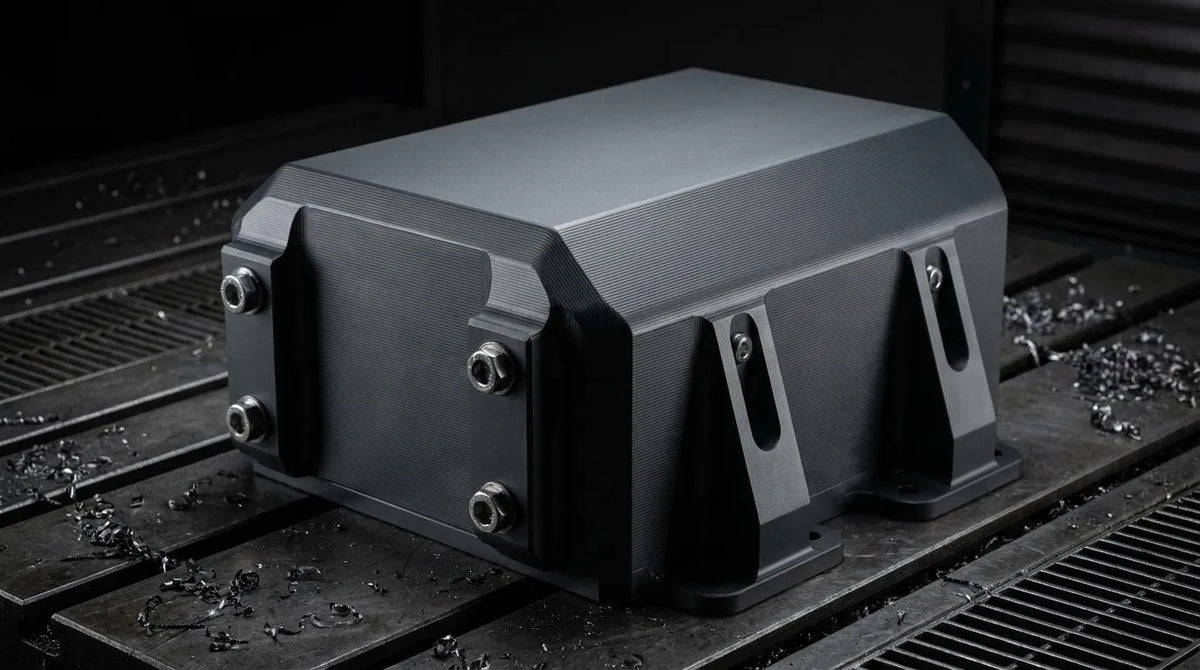
CNC machining for agricultural robots is the specialized manufacturing process of producing ruggedized chassis components, precision soil-sampling end-effectors, and all-weather actuator housings for autonomous farming systems. Ag-tech robotics demand an extreme balance of structural durability, resistance to chemical fertilizers and soil abrasion, and absolute sealing integrity for outdoor operation. Alloyer specializes in precision 5-axis CNC machining for agricultural robotics with 72-hour delivery, zero minimum order quantity, and automated DFM reviews.
 Caption: A high-precision CNC-machined 5083 marine-grade aluminum housing for an agricultural robot. Alloyer maintains strict H7 tolerances for sensor ports and Ra 0.8 μm surface finishes on sealing glands to ensure IP67 waterproof performance in muddy field conditions.
Key Things to Know About CNC Machining for Agricultural Robots
- Material Selection for Corrosion: Aluminum 5083 (marine-grade) is the standard for chassis parts exposed to fertilizer, while PEEK is selected for soil-contact sensors due to its chemical inertness.
- Sealing Integrity (IP67/IP69K): Outdoor robots must survive rain and high-pressure cleaning. CNC-machined O-ring grooves require sub-micron flatness to prevent moisture ingress into embodied AI controllers.
- Vibration Resistance: Rough field terrain subjects robot links to continuous mechanical shock. CNC machining from solid billets ensures grain-aligned structural strength far superior to casting or 3D printing.
- Surface Hardness for Abrasion: Soil is abrasive. Parts like weeding arms and harvesting claws require Type III Hardcoat Anodizing to prevent rapid material loss from grit and dust.
- DFM for Field Maintenance: Incorporating threaded inserts (Helicoils) and captive fastener pockets allows for reliable field repair by farm technicians without stripping aluminum threads.
Why Agricultural Robots Demand Specialized CNC Machining
Autonomous farming—ranging from robotic weeders to autonomous orchard pickers—operates in the most mechanically taxing environment. Unlike warehouse AMRs, ag-bots face UV exposure, wide temperature swings, and corrosive chemicals.
Chemical Resistance and Galvanic Insulation
Fertilizers and pesticides are highly corrosive to standard aluminum. CNC machining allows for the use of Aluminum 5083-H116, which features high magnesium content for superior marine-grade corrosion resistance. For components where titanium is used for high strength, Alloyer integrates machined Delrin or PEEK isolators to prevent galvanic corrosion between dissimilar metals in damp soil environments.
Ruggedized Sensor Mounts
Agricultural AI depends on LiDAR and multispectral cameras to distinguish crops from weeds. Vibrations from heavy tractor-tread tracks can "blur" this sensor data. CNC-machined structural mounts provide the high stiffness-to-weight ratio required to suppress these oscillations, ensuring a stable platform for the robot's perception layers.
Rapid Prototyping for Seasonal Windows
Agriculture has strict seasonal deadlines. A delay in deploying a weeding robot can miss the entire growing window. Alloyer’s 1-piece prototyping and 72-hour delivery allow ag-tech startups to iterate on harvester designs and sensor mounts in days rather than months, ensuring hardware is ready before the first sprout appears.
Material Properties for Agricultural Robotics Components
| Material | Density (g/cm³) | Yield Strength (MPa) | UTS (MPa) | Corrosion Resistance | Machinability | Cost Index | Ag-Tech Application |
|---|---|---|---|---|---|---|---|
| Al 5083-H116 | 2.66 | 228 | 317 | Outstanding | Fair | 1.1x | |
| Al 6061-T6 | 2.70 | 276 | 310 | Good | Excellent | 1.0x | |
| Al 7075-T6 | 2.81 | 503 | 572 | Poor | Good | 1.5x | |
| Ti-6Al-4V | 4.43 | 880 | 950 | Outstanding | Poor | 8.0x | |
| PEEK | 1.30 | 100 | 110 | Excellent | Medium | 15.0x | |
| POM (Delrin) | 1.41 | 65 | 70 | Good | Excellent | 0.8x | |
| 17-4PH Steel | 7.80 | 1170 | 1310 | Good | Fair | 3.5x |
Critical Components: CNC Requirements
1. Ruggedized Sensor Hubs
Function: Mount multi-spectral cameras and GPS antennas in a single calibrated unit. Material: Aluminum 6061-T6 (with Hardcoat). Tolerance: Angular alignment within ±0.05°; H7 bores for optical lens mounting. Surface Finish: Ra 1.6 μm + Type III hardcoat. CNC Challenges: Complex 5-axis geometries are often needed to provide clear fields of view while shielding sensors from branches. Alloyer utilizes simultaneous 5-axis milling to eliminate stack-up errors.2. IP67-Rated Actuator Enclosures
Function: Protect joint motors and reducers from mud and high-pressure water spray. Material: Al 5083 or Al 7075-T6. Tolerance: O-ring groove depth within ±0.03 mm; concentricity within 0.05 mm. Surface Finish: Ra 0.8 μm inside seal glands. CNC Challenges: Maintaining sub-micron flatness on the mating flanges of large enclosures to prevent "seeping" under high-pressure cleaning cycles.3. Soil-Sampling End-Effectors
Function: Physically penetrate soil to measure moisture or nutrients. Material: Titanium Grade 5 or hardened 17-4PH Stainless Steel. Tolerance: Sharpness of leading edge within 0.05 mm; g6 shaft fit. Surface Finish: Ra 0.4 μm for low-friction soil penetration. CNC Challenges: Machining hardened alloys with high-aspect-ratio features without tool breakage.Tolerances & Surface Finishes for Ag-Robots
| Feature | Specified Tolerance | Required Surface Finish | Manufacturing Notes |
|---|---|---|---|
| Bearing Bore | H7 (+0.021/0 mm) | Ra 0.8 μm | |
| IP67 Seal Gland | Depth: ±0.03 mm | Ra 0.8 μm | |
| Mating Flange | Flatness: 0.015 mm | Ra 1.6 μm | |
| Actuator Shaft | g6 (-0.007/-0.020 mm) | Ra 0.4 μm | |
| Threaded Holes | 6H | Ra 3.2 μm |
DFM Tips for Agricultural Robot Parts
1. Specify Internal Radii for Mud Shedding
Deep internal corners in chassis pockets catch mud and fertilizer, leading to localized corrosion. Maintain an internal radius of at least 4 mm (R4) to allow mud to wash out and to support the use of larger, more rigid CNC tools.
2. Wall Thickness for Rough Handling
Agricultural environments are unforgiving. Maintain a minimum wall thickness of 2.0 mm in 6061/7075 aluminum to prevent buckling from accidental impacts with rocks or farm equipment. For non-metallic PEEK sensor mounts, aim for 3.0 mm.
3. Incorporate "Drainage Holes" in Pocketing
If a structural frame includes weight-reduction pockets, always design a 2-3 mm drainage hole at the lowest point. This prevents stagnant water and chemical residue from pooling inside the part, drastically extending the life of the anodized layer.
4. Use 5-Axis to Consolidate Seals
Every bolt and mating face is a potential leak path. 5-axis CNC machining allows for the consolidation of three separate brackets into one monolithic part. This reduces part count, assembly time, and the number of O-rings required to achieve an IP67 rating.
Cost & Lead Time Reference
| Material | Typical Lead Time | Relative Cost | Min Qty | Recommended Use |
|---|---|---|---|---|
| Al 6061-T6 | 3-5 days | 1.0x | 1 pc | |
| Al 5083-H116 | 5-7 days | 1.1x | 1 pc | |
| Al 7075-T6 | 5-7 days | 1.5x | 1 pc | |
| SS 17-4PH | 5-7 days | 2.5x | 1 pc | |
| Ti-6Al-4V | 7-10 days | 8.0x | 1 pc | |
| PEEK | 5-7 days | 15.0x | 1 pc |
Frequently Asked Questions
Q: What is the best material for an autonomous weeder robot chassis?
We recommend Aluminum 5083-H116. It is a marine-grade alloy with excellent resistance to the chemical fertilizers and moisture found in farm fields. It provides high structural integrity while remaining lighter than steel, maximizing the robot's battery runtime.
Q: How do you achieve IP67/IP69K sealing with CNC parts?
IP67 requires a perfect seal under immersion. Alloyer machines O-ring glands to a Ra 0.8 μm finish with a flatness tolerance of ±0.02 mm on mating surfaces. We recommend using face-mount O-rings with custom-machined "compression stops" to ensure consistent sealing across the entire perimeter.
Q: Can Alloyer machine soil-penetrating parts in Titanium?
Yes. We machine Titanium Grade 5 (Ti-6Al-4V) end-effectors for soil sampling and harvesting. Titanium offers superior hardness to resist abrasion from grit and stones while being completely immune to soil chemistry corrosion. We hold H7 tolerances on titanium components for high-cycle robotic assembly.
Q: Why is 1-piece CNC prototyping important for Ag-tech?
Farming equipment must work correctly the first time it hits the field. 1-piece CNC allows you to test the actual strength of a harvester link or the focus of a camera mount in the final material (e.g., 5083 Aluminum) in just 72 hours, validating the design before the planting season begins.
More from Alloyer Blog
Need precision agricultural robot components fast?
Upload your CAD files to Alloyer’s automated engine for an instant price quote and a free DFM check. Standard AL 6061 parts start from $8.99, and we accept 1-piece prototyping orders.
Upload CAD & Get Quote →