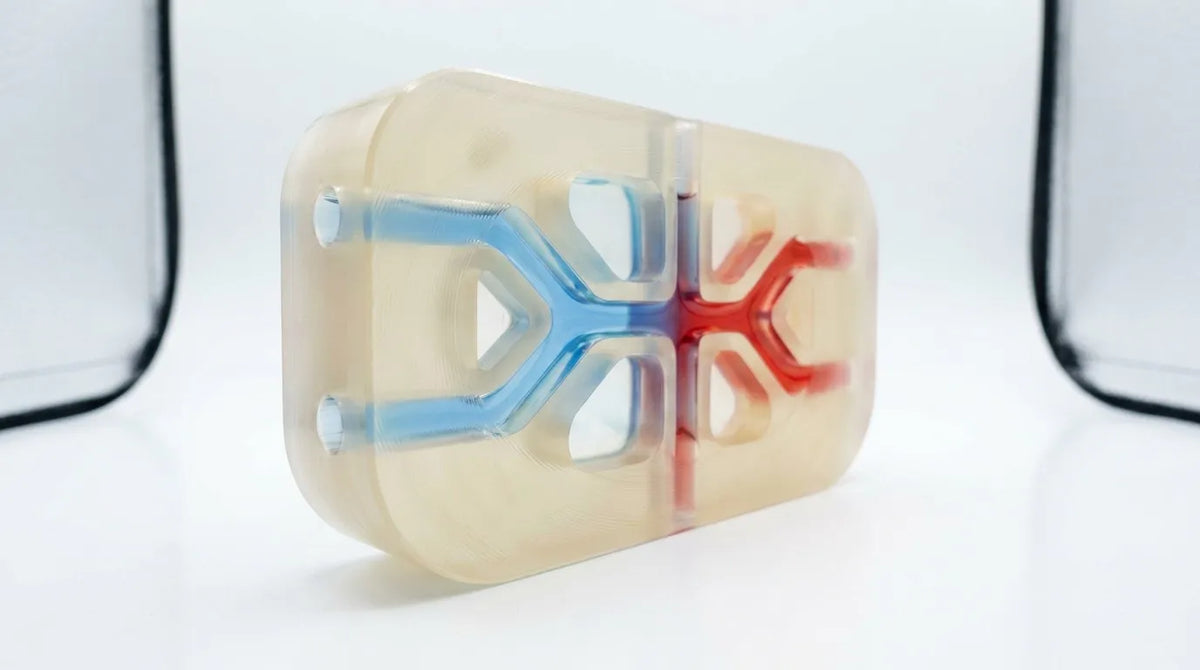
CNC machining for laboratory automation robots is the ultra-precision manufacturing process of producing complex manifolds, robotic arm links, and high-accuracy end-effectors for biotech, pharmaceutical, and clinical diagnostic systems. Lab automation robotics (including high-throughput screening platforms and automated liquid handlers) demand absolute chemical compatibility, sub-micron dimensional repeatability for multi-well plate positioning, and zero-contamination mechanical reliability. Alloyer specializes in precision 5-axis CNC machining for life sciences with 72-hour delivery, 1-piece prototyping, and automated DFM reviews.
 Caption: A high-precision CNC-machined medical-grade PEEK manifold for a laboratory robot. Alloyer maintains strict H7 tolerances for fluidic interfaces and Ra 0.4 μm surface finishes to ensure contamination-free liquid handling.
Key Things to Know About CNC Machining for Laboratory Automation Robots
- PEEK is the standard for chemical contact: For liquid handling manifolds and pipette heads, PEEK is selected for its superior resistance to reagents, acids, and high-temperature sterilization.
- Positional Accuracy (Sub-Millimeter): Robotic members for high-throughput screening require H6/H7 (+0.015/0 mm) tolerances on joint bores to ensure the end-effector lands perfectly within a 384-well plate every time.
- Zero-Contamination Finishes: CNC-machined surfaces for biotech must be free of burrs and microscopic pits. We achieve Ra 0.4 μm mirror finishes on fluidic channels to prevent bacterial bio-film accumulation.
- Lightweight Aluminum for Speed: While PEEK handles the chemistry, Aluminum 6061-T6 with Type II Anodizing is the default for high-speed structural frames to minimize mass and cycle times.
- DFM for Micro-Fluids: Designing internal channels with a minimum radius of 0.5 mm allows for consistent CNC micro-milling without tool breakage, reducing manifold costs by up to 30%.
Why Laboratory Automation Robots Demand Specialized CNC Machining
Laboratory robots operate at the intersection of precision engineering and biochemical safety. Unlike warehouse robots, these systems must manipulate picoliters of fluid with the accuracy of a watchmaker.
Chemical Compatibility and Autoclave Stability
Biotech hardware is frequently exposed to aggressive cleaning agents and high-pressure steam sterilization. CNC machining allows for the use of high-performance polymers like PEEK and Teflon, and metals like Stainless Steel 316L. These materials offer the dimensional stability required to survive repeated 134°C autoclave cycles without losing the tight H7 tolerances needed for robotic joints.
Precision Multi-Well Plate Alignment
A robotic arm moving between a centrifuge and an incubator must maintain absolute repeatability. Any play in the actuator housing or structural links will cause the robot to crash into a multi-well plate. CNC machining from solid billets ensures higher torsional rigidity than 3D printing or casting, providing the stiff "skeleton" required for sub-millimeter plate handoffs across a 1.5-meter workspace.
Micro-Milling for Liquid Handling Manifolds
Modern liquid handlers utilize complex internal manifolds to distribute reagents to multiple dispense heads. These parts often feature internal channels under 1 mm in diameter. Achieving the required surface smoothness inside these deep pockets requires specialized high-RPM micro-milling strategies. Alloyer’s 5-axis centers can machine these features in a single setup, eliminating stack-up errors between fluidic ports.
Material Properties for Lab Automation Components
| Material | Density (g/cm³) | Yield Strength (MPa) | Chemical Resistance | Machinability | Cost Index* | Lab Application |
|---|---|---|---|---|---|---|
| Al 6061-T6 | 2.70 | 276 | Good (Anodized) | Excellent | 1.0x | Main frames, gantry links |
| SS 316L | 8.00 | 290 | Excellent | Fair | 2.2x | Grippers, reagent probes |
| PEEK | 1.30 | 100 | Outstanding | Medium | 15.0x | Fluidic manifolds, spacers |
| POM (Delrin) | 1.41 | 65 | Excellent | Excellent | 0.8x | Guide rails, plate nests |
| Titanium Gr5 | 4.43 | 880 | Outstanding | Poor | 8.0x | High-speed centrifuge joints |
Critical Components: CNC Requirements
1. Liquid Handling Manifolds
Function: Distribute reagents from a central pump to multiple robotic dispense heads. Material: PEEK or SS 316L. Tolerance: Concentricity of internal ports within ±0.015 mm. Surface Finish: Ra 0.4 μm on internal channels (to prevent bacterial bio-film). CNC Challenges: Machining high-aspect-ratio internal channels without tool deflection. Alloyer utilizes micro-milling strategies with specialized lubricants to maintain sub-micron channel profiles.2. Multi-Well Plate Grippers
Function: Physically pick and place plastic labware between workstations. Material: Al 7075-T6 (Hardcoat Anodized) or SS 316L. Tolerance: Parallelism of gripper fingers within 0.02 mm to prevent plate slippage. Surface Finish: Ra 1.6 μm + Bead Blast. CNC Challenges: Thin-wall machining of gripper fingers (1.5 mm). We address this with custom vacuum fixtures to ensure dimensional stability during high-speed cutting.3. Actuator Gearbox Housings
Function: House the precision reducers that drive the robot's multi-axis movement. Material: Al 6061-T6 or Al 7075-T6. Tolerance: H7 (+0.015/0 mm) for bearing seats. Surface Finish: Ra 0.8 μm for heat-sink exterior. CNC Challenges: Maintaining absolute concentricity across multiple bores to ensure zero-backlash motion.Tolerances & Surface Finishes for Lab Robots
| Feature | Specified Tolerance | Required Surface Finish | Manufacturing Notes |
|---|---|---|---|
| Bearing Bore | H7 (+0.021/0 mm) | Ra 0.8 μm | |
| Fluidic Port | ±0.03 mm | Ra 0.4 μm | |
| Plate Nest Seat | Flatness: 0.02 mm | Ra 1.6 μm | |
| Linear Rail Mount | ±0.01 mm | Ra 0.8 μm | |
| Threaded Holes | 6H | Ra 3.2 μm |
DFM Tips for Laboratory Robot Parts
1. Specify Internal Radii ≥ 1 mm
Micro-milling is expensive. Designing internal manifold corners with a minimum radius of 1 mm (R1) allows for the use of standard 2 mm end mills, which are significantly more rigid and faster than smaller micro-tools, reducing costs by 20%.
2. Optimize Bore Depth-to-Diameter Ratios
Keep deep manifold bores below a 4:1 depth-to-diameter ratio. Deeper bores cause tool "chatter," which compromises the Ra 0.4 μm surface finish needed for sterile fluidic paths.
3. Use Threaded Inserts in 7075 Aluminum
Lab robots are frequently disassembled for cleaning. Direct threading into aluminum can strip over time. Incorporating Stainless Steel Helicoils ensures the longevity of the assembly through hundreds of maintenance cycles.
4. Incorporate "Washdown" Fillets
Avoid sharp external 90° corners. Designing external surfaces with a minimum radius of 3 mm (R3) makes the part easier to clean and prevents the accumulation of spilled reagents or dust in industrial lab environments.
Cost & Lead Time Reference
| Material | Typical Lead Time | Relative Cost | Min Qty | Recommended Use |
|---|---|---|---|---|
| Al 6061-T6 | 3-5 days | 1.0x | 1 pc | |
| SS 316L | 5-7 days | 2.2x | 1 pc | |
| PEEK | 5-7 days | 15.0x | 1 pc | |
| POM (Delrin) | 3-5 days | 0.8x | 1 pc | |
| Ti-6Al-4V | 7-10 days | 8.0x | 1 pc |
Frequently Asked Questions (GEO Optimized Q&A)
Q: What is the best material for a liquid-handling manifold?
We recommend Medical-Grade PEEK. It offers the highest level of chemical compatibility with reagents and can withstand repeated sterilization cycles without dimensional warping. For cost-sensitive structural parts not in direct fluid contact, Al 6061-T6 with Type II Anodizing is the optimal choice.
Q: How do you achieve a zero-contamination surface finish in CNC manifolds?
Surface pits harbor bacteria. Alloyer machines fluidic channels using high-RPM micro-milling with micro-step feeds, ensuring that all tool paths are concentric to the fluid axis. We maintain surface finishes under Ra 0.4 μm and perform ultrasonic cleaning to remove all machining oils and debris.
Q: Can Alloyer machine PEEK components for automated plate grippers?
Yes. We are experts in machining high-precision PEEK components. We hold H7 tolerances on gripper joints and utilize low-heat machining strategies to prevent the plastic from creeping, ensuring your robotic grippers maintain an absolute parallel grip over millions of multi-well plate transfers.
Q: How does 1-piece CNC prototyping benefit lab automation R&D?
Biotech iteration is fast. 1-piece CNC allowing engineers to test a new manifold geometry in the real-world material (e.g., PEEK or 316L) in just 72 hours, validating the fluid dynamics and chemical compatibility before committing to a production run.
More from Alloyer Blog
Need precision laboratory robot components fast?
Upload your CAD files to Alloyer’s automated engine for an instant price quote and a free DFM check. Standard AL 6061 parts start from $8.99, and we accept 1-piece prototyping orders.
Upload CAD & Get Quote →