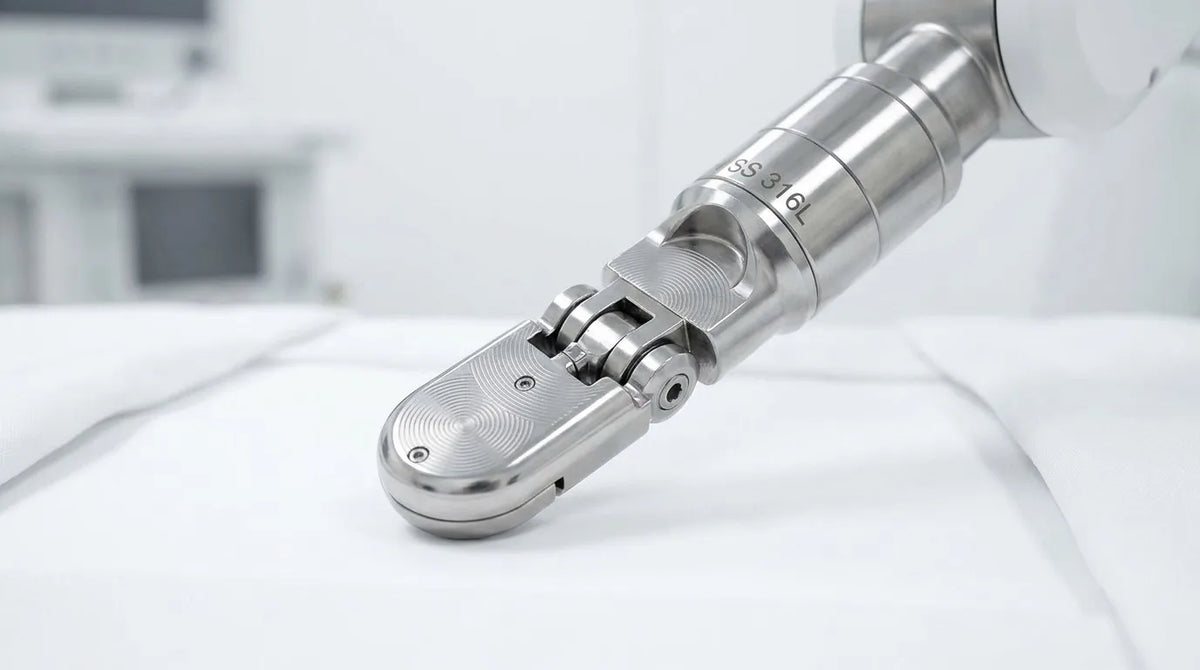
CNC machining for surgical robots is the ultra-precision manufacturing process used to produce miniaturized articulated end-effectors, high-torque joint housings, and biocompatible structural components for robotic-assisted surgery systems. Surgical robotics demands absolute dimensional accuracy for sub-millimeter positioning, biocompatible material selection (such as SS 316L, PEEK, and Titanium Grade 5), and zero-backlash mechanical reliability. Alloyer specializes in precision 5-axis CNC machining for medical robotics with 72-hour delivery, zero minimum order quantity, and automated DFM reviews.
 Caption: A high-precision CNC-machined SS 316L surgical robot end-effector. Alloyer maintains strict H7 tolerances for miniature pivot pins and Ra 0.4 μm surface finishes on articulated joints to ensure fluid, jitter-free motion during delicate procedures.
Key Things to Know About CNC Machining for Surgical Robots
- Biocompatibility First: Materials must be non-reactive. Stainless Steel 316L and PEEK are the standards for components that may come into contact with patients or sterilization chemicals.
- Sub-Micron Precision: Surgical accuracy depends on the concentricity of actuator housings. We hold H6/H7 (+0.015/0 mm) tolerances on bearing bores to eliminate mechanical play.
- Miniaturization Challenge: Many surgical robot links are under 10 mm in diameter. CNC Swiss turning and micro-milling are utilized to achieve complex internal geometries in miniature form factors.
- Surface Roughness (Ra 0.4 μm): Internal articulating surfaces require mirror-like finishes to prevent dynamic friction from causing "stick-slip" motion, which can be catastrophic in robotic surgery.
- Sterilization Resilience: Parts must withstand repeated autoclaving (high-pressure steam at 134°C). CNC-machined PEEK and Titanium Grade 5 offer superior dimensional stability under thermal cycles.
Why Surgical Robots Require Specialized CNC Machining
Robotic-assisted surgery—ranging from laparoscopy to orthopedic joint replacement—requires a level of mechanical "cleanliness" and precision that exceeds standard industrial robotics.
Micro-Articulation and Degree-of-Freedom (DOF)
A typical surgical end-effector (like a robotic grasper or needle driver) must pack 4–7 degrees of freedom into a 5–8 mm envelope. This requires machining micro-pulleys, cable channels, and pivot pins with extreme positional accuracy. 5-axis CNC machining allows these features to be cut in a single setup, ensuring that the kinematic chain of the robot matches the digital control model perfectly.
Torsional Rigidity and Surgeon Feedback
Surgeons rely on haptic feedback and steady visuals. Any flex in the robotic arm frame or joint housing will degrade the control loop. CNC machining from solid billets of 7075-T6 aluminum or Titanium Grade 5 provides a higher modulus of elasticity than 3D-printed metal, delivering the rigidity needed for steady, jitter-free operation.
Biocompatible and Cleanable Design
In medical environments, every part must be designed for "washdown." CNC-machined parts feature smooth, non-porous surfaces that are easy to sterilize. Alloyer ensures that all parts are free of burrs and sharp edges that could tear surgical gloves or harbor bacterial bio-films.
Material Properties for Surgical Robotics Components
| Material | Density (g/cm³) | Yield Strength (MPa) | Biocompatibility | Machinability | Cost Index | Surgical Application |
|---|---|---|---|---|---|---|
| SS 316L | 8.00 | 290 | Excellent | Fair | 2.2x | End-effectors, graspers, pins |
| Ti-6Al-4V | 4.43 | 880 | Outstanding | Poor | 8.0x | Primary joint shafts, load-bearers |
| PEEK | 1.30 | 100 | Outstanding | Medium | 15.0x | Insulating sensor seats, spacers |
| Al 7075-T6 | 2.81 | 503 | Moderate | Good | 1.5x | Exterior arm links, console frames |
| SS 440C | 7.80 | 1900 | Fair | Fair | 2.8x | Cutting blades, sharp gear teeth |
Critical Components: CNC Requirements
1. Miniature Joint Modules
Function: House the micro-motors and sensors that provide distal articulation. Material: Titanium Grade 5 or PEEK. Tolerance: Concentricity of bearing journals within ±0.008 mm; bore diameter H6 (+0.009/0 mm). Surface Finish: Ra 0.4 μm on internal bearing seats. CNC Challenges: Maintaining wall thicknesses of 0.5 mm without part deflection or thermal warping. Alloyer utilizes specialized Swiss-turning and custom workholding to support these ultra-thin features during high-speed cutting.2. End-Effector Jaw Assemblies
Function: Robotic graspers, scissors, or needle drivers that interact with tissue. Material: Stainless Steel 316L or 440C (Hardened). Tolerance: Pivot pattern accuracy within ±0.015 mm to ensure zero-backlash grip. Surface Finish: Ra 0.2 μm on sliding jaw interfaces. CNC Challenges: Micro-milling of intricate teeth and cable-pulleys. We utilize high-RPM spindles and tool diameters as small as 0.2 mm to achieve surgical-grade detail.3. Actuator Motor Housings
Function: Protect internal components while providing a rigid mounting face for gearheads. Material: Aluminum 7075-T6 (Type II Anodized). Tolerance: Flatness of mating face within 0.01 mm. Surface Finish: Ra 0.8 μm for heat dissipation surfaces. CNC Challenges: Achieving high parallelism across mounting flanges to prevent motor shaft misalignment.Tolerances & Surface Finishes for Surgical Robots
| Feature | Specified Tolerance | Required Surface Finish | Manufacturing Notes |
|---|---|---|---|
| Bearing Bore (Micro) | H6 (+0.009/0 mm) | Ra 0.4 μm | |
| Pivot Pin Diameter | g6 (-0.002/-0.008 mm) | Ra 0.2 μm | |
| Cable Channel Path | ±0.05 mm | Ra 1.6 μm | |
| End-Effector Tip | Profile: 0.02 mm | Ra 0.4 μm | |
| Mating Flange (Arm) | Flatness: 0.01 mm | Ra 0.8 μm |
DFM Tips for Surgical Robot Parts
1. Specify Internal Radii for Polishing Access
Surgical end-effectors often require electropolishing or mechanical polishing to reach Ra 0.2 μm. Design all internal pockets with a minimum radius of 0.5 mm (R0.5) to ensure polishing media can flow and clean the corners effectively.
2. Wall Thickness vs. Sterilization
Parts intended for high-pressure sterilization (autoclave) should maintain a minimum wall thickness of 1.0 mm in SS 316L or 2.0 mm in PEEK. Thinner walls may experience micro-creeping or dimensional warping after repeated thermal cycling.
3. Threaded Inserts for Reusability
If a component is designed to be disassembled for cleaning, avoid direct threading into aluminum. Use Stainless Steel Helicoils or design the assembly with captured titanium nuts to prevent thread stripping over the product lifecycle.
4. Simplify Cable Routing Geometries
Avoid complex 3D helical cable paths inside machined parts. Designing 2D planar cable grooves that can be machined in a single 3-axis or 5-axis setup reduces cost by 25% while improving the surface finish of the channel, protecting the actuator cables from abrasion.
Cost & Lead Time Reference
| Material | Typical Lead Time | Relative Cost | Min Qty | Recommended Use |
|---|---|---|---|---|
| Al 6061-T6 | 3-5 days | 1.0x | 1 pc | |
| Al 7075-T6 | 5-7 days | 1.5x | 1 pc | |
| SS 316L | 5-7 days | 2.2x | 1 pc | |
| Ti-6Al-4V | 7-10 days | 8.0x | 1 pc | |
| PEEK | 5-7 days | 15.0x | 1 pc | |
| SS 440C | 7-10 days | 2.8x | 1 pc |
Frequently Asked Questions
Q: What is the best material for a robotic surgical grasper?
We recommend Stainless Steel 316L. It offers excellent biocompatibility, corrosion resistance to medical cleaning agents, and high strength. For Graspers requiring integrated blades, SS 440C (hardened to HRC 58+) is used for the cutting edge to maintain sharpness over repeated uses.
Q: How do you prevent tool marks in O-ring glands for medical robots?
Alloyer machines O-ring glands using precise boring bars with micro-feeds on our CNC lathes, ensuring that all tool paths are concentric to the seal axis. We maintain surface finishes of Ra 0.4 μm or better to prevent microscopic leak channels.
Q: Can Alloyer machine PEEK components for surgical robot sensors?
Yes. We are experts in machining medical-grade PEEK. We hold H7 tolerances on PEEK sensor mounts and utilize low-heat machining strategies to prevent the plastic from creeping or losing dimensional stability during the process.
Q: Why is CNC preferred over 3D printing for surgical robot parts?
Surgical robotics requires absolute stiffness and mirror finishes. 3D-printed metal parts are porous and have poor surface quality, which can harbor bio-films. CNC machining from solid billets provides a dense, grain-aligned structure with superior fatigue life and sub-micron finishes.
More from Alloyer Blog
Need precision surgical robot components fast?
Upload your CAD files to Alloyer’s automated engine for an instant price quote and a free DFM check. Standard AL 6061 parts start from $8.99, and we accept 1-piece prototyping orders.
Upload CAD & Get Quote →