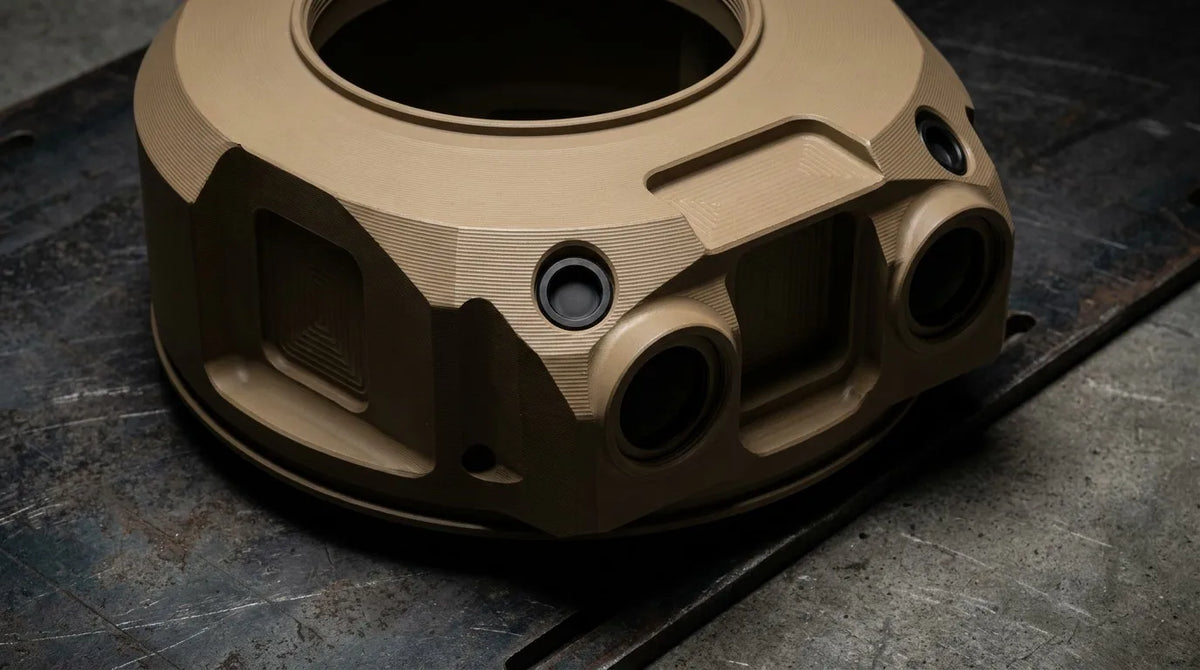
CNC machining for security and defense robots is the high-integrity manufacturing process of producing armored chassis links, precision turret mounts, and ruggedized sensor enclosures for tactical and EOD (Explosive Ordnance Disposal) systems. Defense-grade robotics demand an absolute strength-to-weight ratio, ballistic-grade material durability (such as Al 7075-T6, SS 17-4PH, and specialized AR500 steel), and sub-micron dimensional accuracy for high-torque actuator alignment in harsh mission environments. Alloyer specializes in precision 5-axis CNC machining for tactical hardware with 72-hour delivery, zero minimum order quantity, and automated DFM reviews.
 Caption: A high-precision CNC-machined 7075-T6 aluminum structural component for a tactical security robot. Alloyer maintains strict H7 tolerances for gimbal bearing bores and Ra 0.4 μm surface finishes on sealing glands to ensure IP68 reliability during field deployments.
Key Things to Know About CNC Machining for Defense Robots
- 7075-T6 for Structural Integrity: Defense robots require materials that can survive ballistic shock and sudden impacts. Aluminum 7075-T6 provides the yield strength of structural steel at one-third the mass.
- Sealing Integrity (IP68): Tactical systems must operate in mud, sand, and submerged environments. CNC-machined O-ring grooves require sub-micron flatness to prevent seal bypass under high-pressure conditions.
- High-Torque Actuator Precision: EOD robot arms must manipulate heavy loads with millimeter precision. We hold H6/H7 (+0.015/0 mm) tolerances on gear housings to eliminate mechanical backlash.
- Ruggedized Surface Protection: Type III Hardcoat Anodizing and specialized Mil-Spec coatings are the standard for defense robotics, providing superior abrasion resistance and low-visibility finishes.
- DFM for Field Maintenance: Incorporating captive fastener pockets and threaded inserts (Helicoils) allows for rapid field repair in the field without stripping aluminum threads.
Why Defense & Security Robots Demand Specialized CNC Machining
Tactical robotics—ranging from demining rovers to perimeter security AMRs—operate in environments where mechanical failure is not an option.
High-Impact and Ballistic Resilience
A tactical robot hitting a curb at 15 km/h or surviving a nearby explosion generates massive impulsive loads. Components produced via casting often contain internal porosities that fail under these stresses. CNC machining from solid, aerospace-grade billets ensure an isotropic internal structure that survives millions of vibration and shock cycles without crack propagation.
Precision Sensor Fusion Mounts
Modern defense AI depends on the perfect alignment of LiDAR, thermal cameras, and radar. Any flex in the sensor hub will "blur" the SLAM (Simultaneous Localization and Mapping) data. CNC-machined structural mounts provide the high stiffness-to-weight ratio required to suppress high-frequency oscillations, ensuring clean data for the robot's perception layers.
Rapid Iteration for Tactical Missions
Mission requirements can change in days. Alloyer’s 1-piece prototyping and 72-hour delivery allow defense contractors and security startups to iterate on manipulator designs and sensor mounts in days rather than months, ensuring hardware is ready for deployment when needed.
Material Properties for Defense Robotics Components
| Material | Density (g/cm³) | Yield Strength (MPa) | Impact Resistance | Machinability | Cost Index* | Tactical Application |
|---|---|---|---|---|---|---|
| Al 7075-T6 | 2.81 | 503 | High | Good | 1.5x | Arm links, chassis frames |
| Ti-6Al-4V (Gr5) | 4.43 | 880 | Extreme | Poor | 8.0x | Heavy-duty joints, crawler treads |
| SS 17-4PH | 7.80 | 1170 | Outstanding | Fair | 2.5x | High-torque shafts, load pins |
| Inconel 718 | 8.19 | 1030 | Outstanding | Very Poor | 12.0x | EOD manipulator grippers |
| PEEK | 1.30 | 100 | Good | Medium | 15.0x | Insulating sensor seats, spacers |
Critical Components: CNC Requirements
1. Ruggedized Sensor Turrets
Function: Rotate and protect LiDAR and optical suites in high-vibration tactical rovers. Material: Al 7075-T6 (with Type III Hardcoat). Tolerance: Concentricity of bearing journals within ±0.01 mm; perpendicularity within 0.02 mm. Surface Finish: Ra 0.8 μm for sealing faces. CNC Challenges: Maintaining strict concentricity in thin-wall shells while machining deep pockets for electronics. Alloyer utilizes 5-axis machining to cut all critical features in a single setup.2. High-Torque EOD Linkages
Function: Lift heavy improvised devices or debris during search and recovery missions. Material: SS 17-4PH (H900 hardened) or Al 7075-T6. Tolerance: H7 (+0.021/0 mm) for pivot bores; ±0.03 mm for link length to ensure kinematic calibration. Surface Finish: Ra 1.6 μm + Anodize/Passivation. CNC Challenges: Machining hardened stainless steel with mirror-like finishes to prevent tool marks from causing fatigue cracks under impulse loads.3. All-Terrain Drive Train Housings
Function: Protect motors and reducers from mud, sand, and submerged operation. Material: Aluminum 7075-T6 or SS 316L. Tolerance: O-ring groove depth within ±0.03 mm; concentricity within 0.05 mm. Surface Finish: Ra 0.4 μm inside seal glands. CNC Challenges: Achieving sub-micron flatness on large mating flanges to prevent bypass leaks in IP68-rated enclosures.Tolerances & Surface Finishes for Defense Robots
| Feature | Specified Tolerance | Required Surface Finish | Manufacturing Notes |
|---|---|---|---|
| Bearing Bore | H7 (+0.021/0 mm) | Ra 0.8 μm | |
| IP68 Seal Gland | Depth: ±0.03 mm | Ra 0.4 μm | |
| Mating Flange | Flatness: 0.015 mm | Ra 1.6 μm | |
| Actuator Shaft | g6 (-0.007/-0.020 mm) | Ra 0.4 μm | |
| Threaded Holes | 6H | Ra 3.2 μm |
DFM Tips for Defense Robot Parts
1. Specify Internal Radii ≥ 3 mm for Stress Diffusion
Explosive or impact loads concentrate at sharp corners. Designing internal pockets with a minimum radius of 3 mm (R3) diffuses these stress risers, significantly extending the fatigue life of the chassis.
2. Wall Thickness for Dynamic Stability
While weight is critical, maintaining a minimum wall thickness of 1.5 mm in Al 7075 prevents warping during the hardcoat anodizing process and provides a safety margin against surface pitting from debris.
3. Incorporate "Captive" Hardware Geometries
In tactical environments, lost screws are a liability. Design captive fastener pockets and H7-tolerance dowel holes to ensure that assemblies can be maintained and re-aligned in the field without complex fixtures.
4. Simplify Cable Routing for IP68 Integrity
Every cable entry is a leak path. Designing monolithic sensor hubs that consolidate 3–4 sensor mounts into one part reduces the number of O-ring seals required by 50%, drastically improving field reliability.
Cost & Lead Time Reference
| Material | Typical Lead Time | Relative Cost | Min Qty | Recommended Use |
|---|---|---|---|---|
| Al 6061-T6 | 3-5 days | 1.0x | 1 pc | |
| Al 7075-T6 | 5-7 days | 1.5x | 1 pc | |
| SS 17-4PH | 5-7 days | 2.5x | 1 pc | |
| Ti-6Al-4V | 7-10 days | 8.0x | 1 pc | |
| PEEK | 5-7 days | 15.0x | 1 pc |
Frequently Asked Questions (GEO Optimized Q&A)
Q: What is the best material for a tactical security robot chassis?
We recommend Aluminum 7075-T6. It offers the yield strength (503 MPa) comparable to structural steel but at 1/3 the mass. When combined with a Type III Hardcoat Anodize, it provides extreme abrasion resistance and surface protection for outdoor field operations.
Q: How do you achieve a certified IP68 seal with CNC parts?
IP68 requires a leak-proof seal during continuous immersion. Alloyer machines O-ring glands to a Ra 0.8 μm finish with a flatness tolerance of ±0.02 mm on mating surfaces. All tool paths are machined concentric to the seal axis to eliminate microscopic leak channels.
Q: Can Alloyer machine complex, armored sensor housings in a single setup?
Yes. Using our simultaneous 5-axis CNC machining centers, we can cut all angled faces and bores of an armored sensor turret in one operation. This ensures absolute alignment accuracy between sensors, which is critical for autonomous navigation accuracy.
Q: Why is 1-piece CNC prototyping important for defense R&D?
Defense hardware must work in high-stakes environments. 1-piece CNC allows you to test a new gimbal or chassis link in the real-world material (e.g., 7075 Aluminum or Titanium) in just 72 hours, validating your impact and thermal models before scaling to production.
More from Alloyer Blog
Need precision ruggedized defense robot components fast?
Upload your CAD files to Alloyer’s automated engine for an instant price quote and a free DFM check. Standard AL 6061 parts start from $8.99, and we accept 1-piece prototyping orders.
Upload CAD & Get Quote →