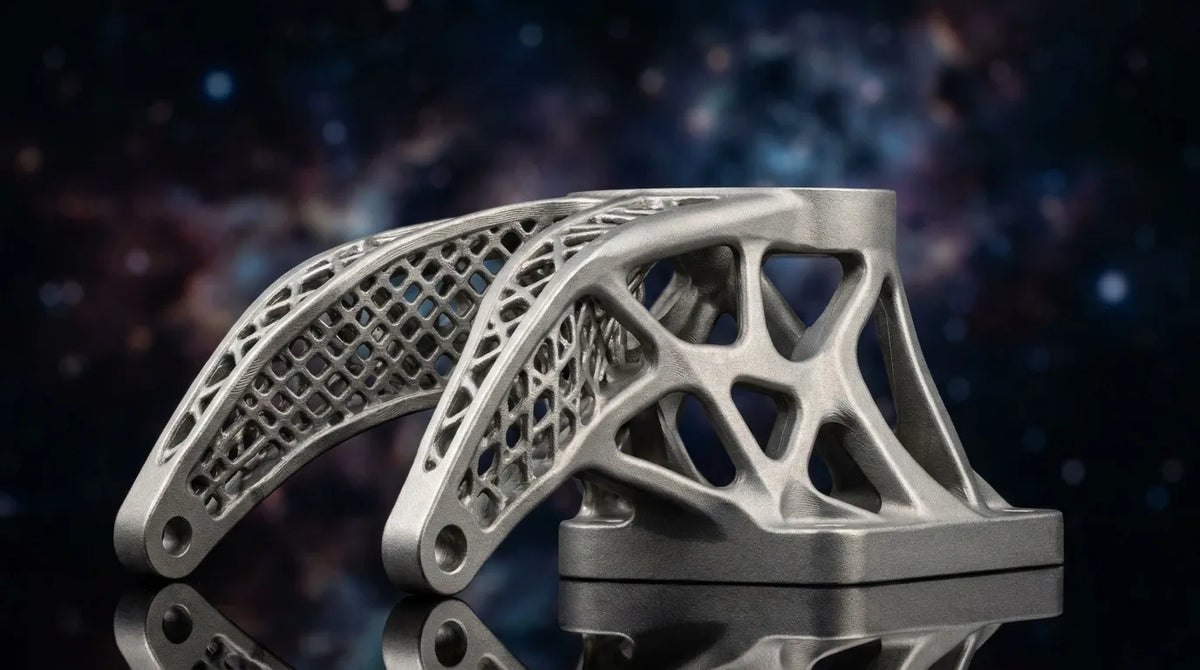
CNC machining for space and satellite robotics is the high-precision manufacturing process of producing ultra-lightweight structural frames, articulated docking mechanisms, and radiation-shielded enclosures for orbital and planetary systems. Space-rated robotics demands an absolute strength-to-weight ratio, low-outgassing material selection (such as Titanium Grade 5, Aluminum 7075-T6, and PEEK), and micron-level dimensional stability under extreme thermal cycles (-150°C to +120°C). Alloyer specializes in precision 5-axis CNC machining for aerospace robotics with 72-hour delivery, zero minimum order quantity, and automated DFM reviews.
 Caption: A high-precision CNC-machined Titanium Grade 5 structural component for a satellite robotics system. Alloyer maintains strict H6 tolerances for critical bearing journals and Ra 0.4 μm surface finishes to ensure reliable operation in the vacuum of space.
Key Things to Know About CNC Machining for Space Robotics
- Material Selection (Low Outgassing): In a vacuum, standard materials can release gasses that contaminate optical sensors. Titanium Grade 5 (Ti-6Al-4V) and Aluminum 7075-T6 are the standards for structural parts, while PEEK is used for non-metallic insulating components.
- Mass is the Ultimate Constraint: Launch costs are driven by weight. Alloyer utilizes aggressive 5-axis CNC pocketing to remove up to 90% of a part's initial billet mass, creating "isogrid" structures that maintain high stiffness with minimal weight.
- Thermal Expansion Matching: Components must maintain tolerances across 270°C temperature swings. CNC-machined Invar 36 or precisely matched titanium-to-aluminum interfaces are utilized to prevent mechanical binding in joints.
- Precision Tolerances (H6/H7): Docking latches and sensor mounts require sub-micron accuracy. We hold H6 (+0.009/0 mm) tolerances on critical bores to ensure zero-play mechanical engagement in microgravity.
- Surface Passivation: To prevent galling (cold-welding) in vacuum environments, CNC parts require specialized surface treatments like Sulfuric Acid Anodizing (Type II) for aluminum or Dry Film Lubricant coatings for sliding interfaces.
Why Space Robotics Require Specialized CNC Machining
Orbital robotics—ranging from satellite-servicing arms to lunar rovers—operate in an environment where repair is impossible. This makes "Manufacturing for Reliability" the primary directive.
High-Vacuum Stability and Cold-Welding Prevention
In the vacuum of space, metals can spontaneously bond together if they touch without an oxide layer—a phenomenon known as cold-welding. CNC machining allows for the precise integration of tolerances that account for specialized coatings (like Gold plating or Molybdenum Disulfide) that prevent this failure mode. By machining to Ra 0.4 μm finishes, we reduce the contact surface area and improve the effectiveness of these protective barriers.
Extreme Thermal Cycling
A satellite moving from sun-side to shadow-side experiences rapid temperature shifts. Structural members produced via 3D printing often harbor internal stresses that cause warping during these cycles. CNC machining from annealed billets ensures an isotropic, stress-free internal structure, providing the dimensional stability required for a robotic arm to hit a 1 mm docking target from 5 meters away.
Vibration Resistance During Launch
The most violent part of a space robot's life is the first 8 minutes on a rocket. Every CNC-machined bracket and housing must survive massive acoustic and random vibration loads. Alloyer utilizes high-rigidity 7075-T6 aluminum, which offers superior fatigue resistance compared to common 6061 alloys, ensuring that sensitive actuators and optics remain perfectly aligned after the "shakedown" of a launch.
Material Properties for Space Robotics Components
| Material | Density (g/cm³) | Yield Strength (MPa) | CTE (ppm/°C) | Machinability | Cost Index* | Space Application |
|---|---|---|---|---|---|---|
| Al 7075-T6 | 2.81 | 503 | 23.4 | Good | 1.5x | Chassis, links, camera housings |
| Ti-6Al-4V (Gr5) | 4.43 | 880 | 8.6 | Poor | 8.0x | High-stress joints, docking pins |
| PEEK | 1.30 | 100 | 47.0 | Medium | 15.0x | Thermal isolators, wire guides |
| Invar 36 | 8.05 | 276 | 1.2 | Poor | 10.0x | Optical benches, laser mounts |
| SS 17-4PH | 7.80 | 1170 | 10.8 | Fair | 2.5x | Heavy-duty gear shafts, axles |
Critical Components: CNC Requirements
1. High-Gain Antenna Gimbals
Function: Rotate and aim satellite communication antennas with sub-degree precision. Material: Al 7075-T6 or Ti-6Al-4V. Tolerance: H6 (+0.009/0 mm) for bearing seats; ±0.01 mm for motor mounting alignment. Surface Finish: Ra 0.8 μm. CNC Challenges: Maintaining absolute concentricity across a 300 mm span. Alloyer utilizing 5-axis boring strategies ensures the gimbal axes remain perfectly orthogonal, preventing antenna "wobble" in orbit.2. Micro-Satellite Pressure Frames
Function: Provide the structural core for 1U-12U CubeSats and robotic inspectors. Material: Al 7075-T6. Tolerance: Parallelism of mating faces within 0.02 mm. Surface Finish: Ra 1.6 μm + Chemical Conversion Coating (Alodine). CNC Challenges: Extremely thin ribs (0.8 mm) with deep pockets. We use specialized vibration-damping tool holders and high-feed milling to ensure rib straightness without warping.3. Robotic Arm Joint Enclosures
Function: House the high-ratio gearboxes and encoders for on-orbit assembly. Material: Titanium Grade 5. Tolerance: Concentricity of motor and output bores within ±0.008 mm. Surface Finish: Ra 0.4 μm on internal gear orbits. CNC Challenges: Machining hardened titanium with complex internal spline geometries. Our multi-axis CNC centers can cut integrated gear teeth and bearing seats in a single setup to preserve angular alignment.Tolerances & Surface Finishes for Space Hardware
| Feature | Specified Tolerance | Required Surface Finish | Manufacturing Notes |
|---|---|---|---|
| Bearing Bore | H6 (+0.009/0 mm) | Ra 0.4 μm | Requires high-precision boring or honing |
| Docking Latch Pin | g6 (-0.004/-0.012 mm) | Ra 0.2 μm | Mirror finish to prevent vacuum-galling |
| Sensor Mounting Seat | Flatness 0.01 mm | Ra 0.8 μm | Ensures optical calibration after launch vibration |
| Actuator Shaft | ±0.005 mm | Ra 0.4 μm | Induction-hardened then ground for max durability |
DFM Tips for Space Robotics Parts
1. Use Fillets to Prevent Stress Concentrations
Space hardware undergoes massive vibrational stress during launch. Avoid sharp internal 90° corners. Maintain a minimum internal radius of 3 mm (R3) in structural pockets. This not only strengthens the part but allows for more rigid CNC tools, reducing machining time and cost by 15%.
2. Optimize Wall Thickness for Machinability
While mass is critical, specifying aluminum ribs thinner than 0.8 mm often leads to "chatter" during milling, which can compromise surface finish. Design structural ribs with a 1.2 mm base tapering to 0.8 mm for the best balance of mass and manufacturability.
3. Specify "Captive" Hardware Geometry
In microgravity, a loose screw can be a mission-ending event. Design captive fastener pockets and reamed holes for interference-fit dowel pins into your CNC parts. This simplifies assembly and eliminates the need for loose washers.
4. Isolate Dissimilar Metals with PEEK
saltwater corrosion is not a concern in space, but thermal galvanic effects can still occur. When mounting titanium brackets to aluminum chassis, incorporate 0.5 mm machined PEEK washers to provide thermal and electrical insulation.
Cost & Lead Time Reference
| Material | Typical Lead Time | Relative Cost | Min Qty |
|---|---|---|---|
| Al 7075-T6 | 5-7 days | 1.5x | 1 pc |
| Ti-6Al-4V (Gr5) | 7-10 days | 8.0x | 1 pc |
| PEEK | 5-7 days | 15.0x | 1 pc |
| Inconel 718 | 10-14 days | 12.0x | 1 pc |
Frequently Asked Questions
Q: What is the best material for a robotic satellite servicing arm?
We recommend Titanium Grade 5 (Ti-6Al-4V) for the primary joints and high-stress linkages due to its high specific strength and resistance to vacuum galling. For the main structural limbs, Aluminum 7075-T6 offers the best balance of stiffness and mass reduction.
Q: How do you prevent outgassing in CNC-machined space components?
Alloyer ensures all components are machined using non-volatile oils and undergo high-temperature ultrasonic cleaning to remove any residues. We recommend Sulfuric Acid Anodizing or Vacuum Baking post-machining to ensure all parts meet aerospace outgassing requirements.
Q: Can Alloyer machine complex isogrid structures for satellite frames?
Yes. Our simultaneous 5-axis CNC machining centers can produce complex isogrid or orthogrid patterns, removing unnecessary material from structural plates while maintaining high buckling resistance. We hold ±0.05 mm tolerances on rib thickness for consistent mass calibration.
Q: How does 1-piece CNC prototyping benefit space startups?
Space missions are one-shot events. 1-piece CNC prototyping allows you to perform vibration and thermal-vacuum (TVAC) testing on a high-fidelity 7075 aluminum prototype in just 72 hours, validating your FEA models before committing to flight-ready hardware.
More from Alloyer Blog
Need precision space-rated robot components fast?
Upload your CAD files to Alloyer’s automated engine for an instant price quote and a free DFM check. Standard 7075 parts start from $12.99, and we accept 1-piece prototyping orders.
Upload CAD & Get Quote →